
“The Parties agree to the following lines of demarcation: one-mile deep demilitarized zones shall be established separating Heaven from Purgatory, and Purgatory from Hell, respectively, along the geodetic positions of the Tropic of Cancer and the Tropic of Capricorn at the time of the Rupture. […] The Parties agree to renounce warfare as a sovereign right and the threat of using force as a means of settling territorial disputes.”
(Article 9 of the Tokyo Convention on Interhemisphere Cooperation)
“A Signatory Party may, under the exceptional conditions specified in the present Agreement, grant the right of resettlement to family members in the ascending line of a minor born as a citizen of a second Signatory, if the minor is granted the right to move and reside unaccompanied within the territory of a third Signatory.”
(Section 45 of the Tripartite Agreement on Migration and Trade)
***
Jerôme’s heart sank when he saw the official wearing a high-visibility yellow badge of the Commonwealth of Purgatory escort a middle-aged couple into the departure hall.
They shouldn’t be here yet. Or more precisely, he and the girl should no longer be here. By now, they ought to sit on an intercontinental flight with shuttered windows heading for the Northern Hemisphere.
All planes had been grounded for hours and an anxious crowd of travellers billowed in the reinforced concrete halls of the dilapidated international terminal at Kingsford Smith. The few foreign-currency shops had run out of bottled water and overpriced snacks to sell – postcards of working-class housing blocks and patriotic memorabilia clad in the uniformly faded red of the People’s Tartarocracy of Hell were the only merchandise left.
The authorities said it was the weather; the ground temperature was far too hot on the tarmac, not to mention the warning about that level-three sand storm coming in from across the Range that was supposed to hit the airport two hours ago. Jerôme, already sticking with sweat under his linen suit, would have welcomed at least a breeze, to make up for the shortfall of the building’s dysfunctional air-conditioning.
He suspected, of course, that the disruption was due to another fuel shortage, which the airport management must have been trying to alleviate behind the scenes, plausibly by diverting a kerosene delivery intended for some local branch of the air force – the customer that paid in worthless joss but always enjoyed priority.
The girl spotted her parents first and darted off before he could grab hold of her.
***
Scenes like this must have been common before the regulation came into effect mandating that families be separated at the Purgatory consulate and flown out at different times. There was no other way to avoid traumatic encounters at the cramped terminal.
Women, men and children each sound different when overcome with grief. This family, however, formed a kind of protective huddle and their hushed crying blended into a soothing drone. Jerôme was prepared for wailing or sobbing, but not for this soft agony of separation.
He must have looked rather helpless, his arm stretched out halfway towards the girl and hesitating mid-air, unsure of whether to try to pull her away. The agent clad in the brown coat of the Purgatory immigration department made efforts to separate the group or, failing that, at least move them aside from the terminal gate’s bottleneck. His badge flashed as it dangled from his collar and identified him as Hamza.
Embarrassed, Jerôme stepped towards him and attempted to convert his previous timid gesture into the offer of a handshake.
“Jerôme Chamberet, Celestial Foreign Service, Department of Ascensions.”
The man called Hamza stared at him for a moment, then barked, “Were you born yesterday? Keep your ward under control!”
Jerôme muttered a flustered apology and resolved to keep his arm to himself, making instead a half-hearted endeavour to extricate the girl from her parents’ embrace.
Hamza paused with a snigger, then hissed, “Are labour shortages so bad your guardians stoop to sending interns now?”
He was already turning to face the demon approaching at the head of a handful of militiamen attracted by the noisier-than-usual commotion. The fiend was walking with laboriously broad strides to compensate for its small stature and wore the platform shoes its kind was so fond off.
Hamza was quick to draw attention to his badge and pull documents from a folder. “Standard Section 45 expatriation, these folks to the Commonwealth, the little one to the North. All paperwork cleared, comrades, just a bit of trouble with the timing.”
The fiend wore the inscrutable poker face of tartarocrats and obviously had no concept of personal space, staring up at the humans from up close. Adults bowed their heads to be level with him, out of a mixture of fear and sheer habit.
The demon pulled its uniform straight and rasped, “Another tearful departure, I see. So many only realise their mistake on the cusp of boarding. Leaving the warmth and safety provided by our workers’ utopia, for what? The nebulous promises of your Commonwealth of scavengers – and that golden cage beyond.”
The family recoiled slightly from its wry smile as it hissed, “Maybe you’d like to stay after all. It’s not yet too late for a change of heart.” It signalled to the militiamen. “Their papers could surely do with another check.”
As if its menacing words had triggered a reflex, the couple closed in swiftly in front of their child and pushed the little girl into Jerôme’s arms. As citizens were not normally allowed to address their overlords directly, the family’s muffled agitation started to attract the attention of other stranded passengers.
With a judicious sidestep, Hamza barred the demon’s path and tried on a conciliatory tone. “Look, comrade, they are under diplomatic protection now. Do you want us to make an even bigger scene? Think of Redfern.” It meted out a dark stare at his mentioning the latest public disturbance in one of Sydney’s slums that, according to the official state news agency, had of course never happened.
The demon made a circular motion with its index claw, at which his squad of auxiliaries set about surrounding the group. The parents’ anxious exclamation drowned out Jerôme’s voice, who had raised his passport with the embossed wings of glory and kept repeating his consular credentials.
Both Hamza and the fiend were opening their mouths to launch into a heated exchange, when the commotion was interrupted by an announcement booming from the terminal’s crackling loudspeakers.
“Attention, comrades! The storm warning has been lifted. All passengers booked on delayed flights are requested to proceed immediately to the gates indicated on the overhead flap displays. Note that the airstrip must be vacated for incoming flights as soon as possible. Proceed directly to your boarding gate as indicated. Clear the departure halls! We repeat: proceed to your boarding gate immediately.”
***
The very image of benevolence, the mandatory propaganda print covering the wall depicted the Archdevil receiving a bouquet of crimson flowers from a plump proletarian child. Hamza thought it ironic that the only well-fed children he saw were those at the Potemkin kindergartens reserved for the offspring of the inner circles. Sure, the school meals were supposed to be free, but the buns purportedly had more sawdust than flour in them. If the factories of Hell produced anything of reasonable quality, it was invariably destined either for export or the armed forces.
Against this backdrop, the drab faces of border control officials, hardened by years of chain-smoking and indoctrination, appeared particularly hostile.
“You heard it. Keep it moving or step out of the line!”
It was not easy shepherding the distraught couple forward. The unplanned encounter with their daughter made naught of the previous day’s carefully orchestrated separation session at the consulate. Hamza had advised them to avoid drawing any further attention to themselves; Southern authorities were notorious for making things difficult in spite of the Tripartite Agreement.
He nudged them up to the next available counter and hit an apologetic tone. “They are having a rough time.”
The woman hunched over the cubicle’s desk was less than impressed. “So does everyone here. What’s with the soft attitude, anyway? It’s your job they’re making difficult, after all.”
“I had children, too.”
“That’s your fault, hence, your problem. Papers, money, now!”
***
Her name was Fatima and she appeared inconsolable, though the plush comfort of the business-class seating afforded to all ascenders and the warm manners of the crew seemed to have reassured her somewhat.
Jerôme remembered his psychological training at the Department, but it seemed all so theoretical now when faced with a real child. Owing to a small, affluent population and minuscule birth rates, one didn’t encounter many children in Heaven, and even fewer that needed comforting.
“You probably feel like today is the worst day of your life”, he said and, after some thought, added, “even for someone born and raised in Hell.”
She gave him a peculiar, sad look, with a hint of reproach. It strangely reminded him of the way the guardians would rest their big, melancholy eyes on him whenever he said something naïve. He felt the urge to justify himself.
“Listen, what you have been through would be difficult for anyone to bear – but you’ll never have to go through anything like this again. You’ve been selected. You made it out!”
“But my mom and dad… They didn’t get to come with me. You took them away and it hurts…”
“Only the innocent may enter Heaven. But they are on their way to Purgatory, for they have raised you, a pure child in Hell. You don’t know how rare you are.”
Fatima strained her voice, on the verge of bursting into tears again, “That’s not fair! My mum said she’d sign us up for a way to leave, but she didn’t say we couldn’t go together. I want to go back! The devils never hurt me this much…”
“No-one will ever harm you again, Fatima. You’ll never hear a mean word spoken or see a bad person again. You won’t have a single worry in your life – as long as you stay pure.”
“I don’t even know what that means…”, she whimpered and swallowed a tear drop.
“It’s not difficult, once you’re in Heaven. There’s so much land, with beautiful forests and clean lakes. And not many people at all. Distances are great, towns are small, and everyone has lots of space to themselves. But you won’t be alone and we’ll take good care of you.”
“If there is so much space, why can’t my parents come? If you like the way they raised me – maybe they could make more children for Heaven!”
“I’m sorry, little one, we don’t create the rules. The guardians do.”
“If they are supposed to be good, why do they make such… horrible rules?”
Jerôme considered his response for a moment, but saw that Fatima was bright enough to begin to understand.
“I believe the Agreement is the only way they can keep the peace.”
***
The Tropics of Cancer and Capricorn were fixed as demarcation lines soon after the confusion of the Rupture, when the gates of Heaven appeared in the sky and the Tartarocracy of Hell manifested in response a few hours later, in an escalating arms race of mutually assured destruction. The first diplomatic settlements were mediated by the hastily assembled, provisional Commonwealth of Purgatory, sandwiched between the two opposing camps along the Equator. The tropics has shifted approximately 450 metres since then, due to variations in the tilt of the Earth’s axis, but impenetrable barriers had been erected all along the demilitarised zones of yore, fixing the borders in place.
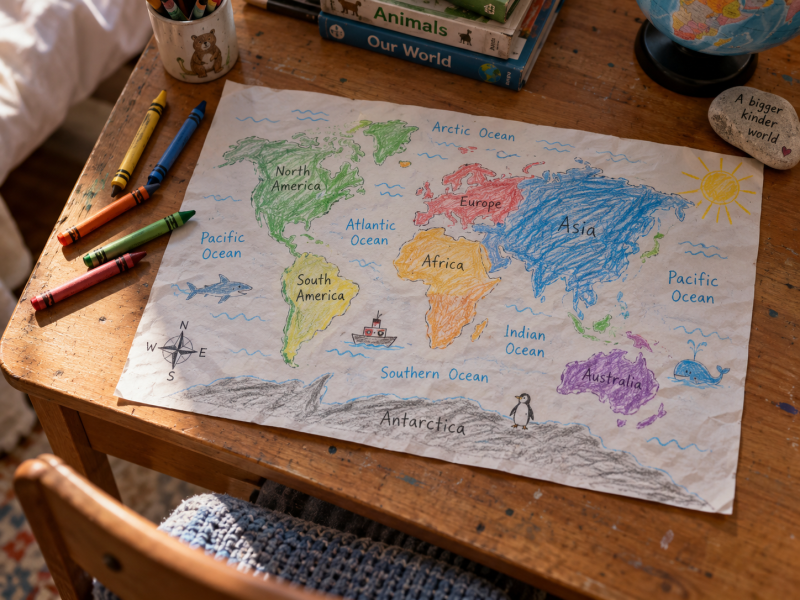
Jerôme glanced at the map of the world Fatima was colouring under the watchful care of a guardian, squatting next to her on its toes, its enormous wings almost enfolding her and the child-sized desk she sat at. As if by instinct, she picked appropriate colours for the regions: a thick black to emboss the demarcation line cutting through Latin America and Africa and slicing Australia roughly in half, with anything south of it blazing under the crimson of the Tartarocracy. The leafy green of Heaven stretched over the vast landmass north of the 23rd latitude that covered all of Europe and North America, along with most of Asia and the Middle East. The troubled yellow of Purgatory was pinned along the centre like an overpopulated hive, with the shores of its insular cells washed by the crayon blue of the planet’s oceans.
He noticed that the guardian was following his gaze, so it was reading his mind now instead of Fatima’s. Jerôme got used to the politeness of these paternal beings who would try not to interrupt others mid-thought, and found interacting with humans increasingly tiresome by comparison.
The guardian smiled and said, “She has made good progress and possesses a calm soul – along with a strangely mischievous demeanour.”
“How is she fitting in?”, Jerôme asked.
“The latest arrival to the care home always finds initial acceptance difficult. The other children are scared of being reminded of their parents and the scars they suffered in Hell.”
Jerôme knelt down next to the girl who had just finished colouring her map.
“I didn’t bring you any sweets this time. Your guardian says those would make you fat.”
It evidently felt the need to explain, “Her dietary needs are being met in the most optimal manner possible. There is no need for you to contribute additional food items.”
Jerôme and Fatima exchanged a smile, as they were wont to whenever her winged companion said something pedantic. He suspected that it knew its dispassionate utterances amused them and therefore kept it up during Jerôme’s visits. Over time, he and the guardian had developed a routine and took turns to explain to the little girl the workings of Heaven, with its verdant landscapes and wealth of resources, and its sparse population, replenished gradually through handpicked invitees from the other realms.
As always when she asked too many questions, the guardian added, “Remember that freedom can be dangerous. Choices often imply bad decisions.”
And Jerôme echoed his advice, “Whatever you do, avoid the taint of misbehaviour. This is your home now.” But she never looked convinced when he said that.
***
Before the Rupture, Kwun Tong had already been one of Hong Kong’s most crowded districts. Cast by the vagaries of geography just south of the demarcation line along the Tropic of Cancer, this teeming vortex of urban cacophony had become one of Purgatory’s northern-most outposts.
Hamza sat in the crammed office of Indira, his assigned federal intern and informal deputy, selected by an arcane three-tier competition – there were thousands of graduates applying for every new post. Their mutual debriefs had become a ritual since she started a year ago. She was leaning against the wall balancing on her heel next to the narrow, grilled window, perhaps to get away from the disorderly pile of coffee-stained papers on her desk.
“How are things in Hell?”, she asked.
“The news aren’t lying, their recession is still deepening. Of course, their official statistics tell a different story, but a fellow from our corporation in the Special Economic Zone told me even they have liquidity problems. The banking system is stuttering – our own premises have been raided by the militia.”
“Yes, I heard about that diplomatic incident. Did anything – slip?”
“No, they seemed to be after bribes more than anything else.”
“The horns-in-chief claim they can read minds.”
“But then why would they need such an elaborate network of informants? Unless it’s just another way of keeping folks occupied. They have full employment in theory, but their fixed prices curb inflation only for show. There’s a black market in just about everything. And you know who is profiting from it? The tartarocrats flaunt their connections to the criminal underworld and compound the damage to the economy with every botched five-year plan. Were it not for those fixed exchange rates, the workforce in the special zones would be getting cheaper by the month.”
“A vicious cycle, then. How are the people coping?”
“The folks they send over – they are getting better all the time. I mean, they are sturdy, keep quiet, willing to do any job. This latest couple… kudos to them, they faced a lot of tough adversity to get here – and to get their daughter to the North.”
Indira nodded, taking a break from chewing her pencil. “Down under sure is a hell of a training ground, if you pardon the pun. And it’s always good to have a neighbour we can compare ourselves favourably with – at least these people know how good they have it here and won’t join the rioters.” She lit a cigarette. “Standard procedure?”
“No such thing any longer. I gave them cash to get them started and temporary papers until they get out of the camp and register with a district. Over there, they did the customary pariah jobs reserved for conscientious objectors or folks who wouldn’t inform on their neighbours – you know, where you actually have to work hard, rather than just look busy when the fiends do their walkabout. I’m sure they find employment soon.”
“And wind up the birthrighters about fugies taking away their jobs.”
“You’ll be hard pressed to show me a native with a job, anyway, with 50% unemployment and all that. We’ve got too many folks already, what with no-one expediting ascensions to the North or enforcing deportations to the South.”
Indira straightened up like she was wont to do whenever she sensed an opportunity for political banter. “If you ask me, our federalists don’t want people to turn truly good or evil. We’ve got a demographic trajectory to preserve. Heaven might have wealth and technology on their side. Hell got its oversized army fed on canned grass and propaganda. But we have more population than the two of them put together. The next generation will grow into adulthood with no memory of the Rupture. Time is on our side.”
Hamza had always liked his intern’s enthusiasm, but could not shake the unease impressed upon him by years of fieldwork. “But we got to tough it out here with billions of others in the meantime. Human nature is funny like that. We keep having kids, although hardly anyone of reproductive age can afford a two-room flat. They in the South breed out of fear that some of their children won’t survive. But then you look at the Northerners: Heaven is rich and vast, for God’s sake, and yet so sparsely populated. No wonder they’re reluctant to have kids, with all their rules and risk aversion. Daily reminders to be a good person, live free of temptation – I reckon they avoid the possibility of harm by avoiding each other!”
“Sure, it’s easy to be serene when you got acres to yourself. But their society is aging and they’re trying to fill those pastures with the vigour of youth again. There are more Section 45s lately. And that’s quite something, given how difficult it is to escape from Hell, with those long waiting lists for visa assessment.”
Perhaps reminded by her latest remark, Hamza pushed a hastily enveloped memo towards her across the desk. “You should know that we do the separation procedure at our Melbourne consulate now. The embassy of Heaven is monitored too closely. You can forget about phone calls. I mean, we keep the lists confidential, of course, though the tartarocrats try their access-to-information routine time and again. It’s the surveillance that makes it so damn difficult to raise a morally pure child and earn the parents’ passage to Purgatory, by making their kid pass the test for ascension.”
Indira fiddled with the envelope, wary of adding to her unread pile. “I wonder how many get screened out and intercepted along the way – at school, at youth training camps, compulsory volunteer work on weekends… or just overzealous neighbours out to get extra ration cards?”
“Yes, sometimes I wonder whether it’s right. Those folks who raise little saints as their ticket out. Once they finally make it over here, they only get a fraction of the quota Heaven pays us for taking them in.”
“Unlike the winged do-gooders, the Commonwealth is not a charity. You think we’d keep lending money to the South we’ll never see again just to satisfy their need for hard currency and keep them from collapsing in a really messy way? Let those guardians fork out for peace. We might be on the front line, but mind you, those red nukes, if they indeed have them, would sure fly right past us, all the way to the North.”
“The Archdevil is not crazy. He knows he’d lose.”
“Sure, Heaven would win. The South might have biologicals and dirty bombs, but the North has G.O.D. Think of the price, though. The fiends would rather destroy humanity then yield – but the guardians would lose their purpose.”
“Unless there’s life on other planets.”
“Ah, until someone shows me proof, that remains superstition. Aliens are a myth we conjure up to comfort ourselves.”
***
The guardian entered the confessional and folded its tall, winged frame into the cabin opposite the little girl. She was fumbling with the laundry tag of her silken dress, one of the many fine clothes issued to her at the reception centre. The inscription read ‘made in Hell (Canberra SEZ)’, which surprised and annoyed her a bit, as she had never encountered soft fabrics like that back home in the South.
They both sat in silence for a while. It was not their first meeting of this kind. Finally, the guardian spoke with the hushed voice reserved for places of reflection.
“So, you are in detention again.”
Fatima nodded slowly.
“This is the second time you’ve spilled food on another child in the refectory. The dish was hot, you know? It could have burnt him.”
She remained quiet, tucked in her chin and glanced up at the guardian expectantly.
“Did he provoke you in any way? Did he do something to annoy you?”
“No”, Fatima shook her head and averted her eyes.
The guardian remained in thought for a moment, then said, “Perhaps you are still finding your place and need a little more time to adjust. I can sense that your heart is pure. I know you are a good child.”
Bursting with sudden impatience, Fatima leaned forward and, with every muscle tense in her little body, retorted sharply, “No, I’m not a good child! I don’t want to be good. What must I do for you to say that I’m bad?”
Taken aback slightly, the guardian nonetheless seemed almost relieved.
“You are doing this on purpose, are you not? All your mischief, and you still manage to keep a pure heart.”
“I’m not – ‘pure’! I don’t want to be here! I want to go back to mum and dad!” She was on the verge of crying now.
“I see. You want to disqualify yourself and go back to Hell, to be reunited with your parents. That’s very noble, in a way – and, for that reason, I’m afraid your intentions are working against you. They turn your sins into virtues.”
“I don’t understand. You must punish me, so that I can go home!”
“That won’t be possible, little one. Your parents will be in Purgatory by now.”
The guardian shuffled forward on the confessional stool and knelt down to envelope Fatima in as comforting hug as it could muster.
“I’m so sorry for not having recognised it earlier. You thought you can taint yourself by being mean to others. You see, I cannot even scold you now. Being in Heaven against your will in punishment enough.”
***
“Adoption, sir?”
The desk clerk at the Department of Public Wellbeing studied Jerôme’s application file and seemed rather uncomfortable with it.
“Is there a problem?”
“The form says you are single, sir.”
“I’m not aware of that being a disqualifying circumstance.”
“Well, it technically isn’t, but you see here you left point 3 empty. It’s a mandatory field.”
“It asks for the name of my spouse. I don’t have one, so I can hardly give her name, can I?”
“According to standard administrative procedures, I’m not allowed to accept the submission of a form if a mandatory field has not been filled out.”
“But you say it is not a prerequisite to have a spouse! So, logically, I must leave that field empty.”
“Oh no, sir, it says here clearly in our regulations that skipping a mandatory field is an omission.”
Enervated, Jerôme decided to change tack. “Can I see your manager, please?”
***
Jerôme has practiced this often, imagining a variety of conversations where he might need to dodge the eerie intuition of the guardians. He had complete scenarios worked out and committed to memory about border crossings, briefing interviews and other exposure situations. He fossicked through his mental suitcase, but nothing came to mind that would suitably mask his true intentions in this case. In the past, he had never seen a need to prepare for parenthood hearings.
Of course, the desk clerk on duty did not want to take responsibility for making a decision, but deferred instead to his superior at the Department, who turned out to be a guardian with an unusually alert appearance that lent it an aura of professional zeal.
Offering Jerôme a seat in its office, it leafed through the dossier with eager attention and cast frequent glances at the applicant. Whenever their eyes met, he did his best to close his thoughts to mental inquiry and focussed instead, as a means of last resort, on crude and annoying things – his hay fever and sweaty armpits.
“Your record is impeccable. This looks promising for you”, the guardian said abruptly and flipped the file closed.
Before Jerôme could express his relief, it carried on, “But you don’t have a companion. It would be difficult to raise a child on your own. You would receive full benefits, of course, but you’d have less discretionary time available for your leisure pursuits. Could you still experience the recommended number of hours of serene contentment per day?”
“I know what’s involved, I was a child once myself.” Seeing that the guardian did not pick up on the meaning of the sideswipe, Jerôme added firmly: “I want to go ahead with it, please.”
“As you wish. I sense that your intentions are altruistic. I’ll add a remark to that effect to your file.”
“Will this remain confidential?”, Jerôme asked after the briefest hesitation.
The winged official girded a rubber band around the dossier with the hint of a smile. “Are you concerned about her privacy, or yours?”
“Your kind reads minds.”
“Indeed, I just read yours. But as for my esteemed colleague, we choose to remain mutually impervious. Conflict of interest, as it were…”
***
Another day, another riot somewhere in Purgatory. A patchwork of chaotic urban hubs connected by vast corridors of slums, the federal system of loosely cooperating city states was creaking under the strain of overpopulation. And yet the Commonwealth encouraged more children and more immigration, in a bid to breed mankind back into control of its planet.
Hamza knew he could easily locate the girl’s parents. First-generation arrivals from Hell were the federation’s most diligent taxpayers. They never had it so well in their lives and usually intended to repay the society that took them in. It turned out both held down two jobs and indeed proved so productive that the government agency rejected their application for a licence for religious education out of hand. They were the kind of people Purgatory was most keen on keeping.
But the official seminaries, funded by the North and operated subject to federal licensing, weren’t the only way to have a shot at passing the entrance exam to relocate to Heaven.
Hamza turned a corner at the familiar kiosk and followed the dissonant scent of incense down a back alley, to Father Ibrahim’s clandestine church nestled in the cellar of a warehouse.
“Ah, you must be getting better at your job. It’s been a while since you last came to me for – guidance”, the gaunt priest exclaimed from under his beard and greeted Hamza with an eager embrace as he entered the small sacristy.
The lingering aroma of freshly brewed tea blended with the room’s stale, comforting air and the two men enjoyed a moment, holding their cups in silence, before the younger one began to speak.
“It is up to the Northerners now to track down suitable candidates. There’d be a lot of willing applicants on those waiting lists of theirs, but those best suited to pass the test of purity don’t often get to put themselves forward. Like some in your flock.”
“I think of you as part of my flock.” Father Ibrahim smiled heartily and added, “Not that you’d ever attempt the exam.”
“I’m not cut out for Heaven, Father. Not yet, anyway. But I know some folks who are.”
“Purgatory needs good people, too. If all the righteous ascend, the society left behind will be all the poorer for it.”
“Yes, I know, that’s why you missionaries left the cushy North, and I respect that, I really do. Most folks would give several limbs to cross Cancer the other way. And perhaps a few of them would really deserve to get that one-way ticket out.”
“Do you have someone specific in mind?”
“An Aussie couple from one of my recent extractions. Humble, hardworking fugies, you know the type. But they have such an earnestness about them, as if something had kept them focussed all those years – you’d hardly believe they had been stuck in Hell ever since the Rupture.”
“You would like me to act as their confessor and help them prepare for the entrance exam?”
“They are good people, the kind you have come here to save. Help them enter that Heaven of yours. Their daughter is already there.”
The priest paused a while, taking stock of the needs of his parishioners and his own dwindling strength, then he nodded at Hamza.
“Fair enough, my son.” Father Ibrahim then added with a playful smile: “If they are accepted for ascension, I’ll add them to your tally. Just in case one day you consider submitting an application after all.”
***
He had lived a few streets away from it for years, yet never before had need of entering the art nouveau mansion housing Purgatory’s consulate on one of the septic, empty boulevards that grid Brussels’ celestial administrative district. Given the lack of prospective travellers, Jerôme could not see a reason why he was kept waiting for so long, unless the representation had suffered staff shortages due to another hushed-up high-level defection.
When he was finally called up, he approached with cautious resolve the counter identified by a crooked sign as the ‘foreign immigration desk’. He laid out his travel document and identification, and uttered the sentence for the first time ever.
“I… wish to submit a visa application.”
“You have a diplomatic passport, sir. You may enter our Commonwealth as often as you please.”
“Alas, my situation no longer fits neatly within procedure. I’d like to apply for a visa for my travel companion.”
“Do you now, sir? But couldn’t your fellow traveller make the application in person?”
“I’m afraid she’s under-age.”
“I see. What is the nature of your relationship with his young lady?”
“She’s… my daughter. And I’m her ticket – out of Heaven.”
***
“The High Contracting Parties
(a) express concern at the growing number of irregular border crossing attempts, and deplore, in particular, the rising human toll of undocumented migratory journeys at sea;
(b) undertake to implement measures to ease and expedite avenues for legal population exchange and repatriation, and provide proactive resettlement assistance to unaccompanied minors and other vulnerable persons;
(c) recognise the need to reduce the prerequisites for obtaining travel permits and increase the success quota of candidates by lowering the pass mark of examinations. […]”
(Recital 3, Preamble to the draft Border Reform Treaty. At the time of printing, it remains unratified by the People’s Tartarocracy due to national security concerns.)
THE END


