Welcome to this Winter 2025 issue, conceived in the classical sense; reflective rather than reactive, inward-looking without being insular. Across nonfiction, poetry, fiction, and visual art, the issue examines how individuals are shaped by inheritance, memory, power, and silence; and how meaning is constructed when continuity is broken, distorted, or deliberately resisted. The contributions are united not by theme alone, but by a shared attentiveness to consequence—emotional, ethical, historical, and aesthetic. What emerges is an issue concerned less with proclamation than with reckoning. It gestures toward a broader turning point we are witnessing across society: a withdrawal from constant reaction and a renewed, if uneasy, return to inward examination.
Get it now from TBR Store or Amazon, in paperback or eBook version.
Featured Artist: Dr. Benjamin Erlandson

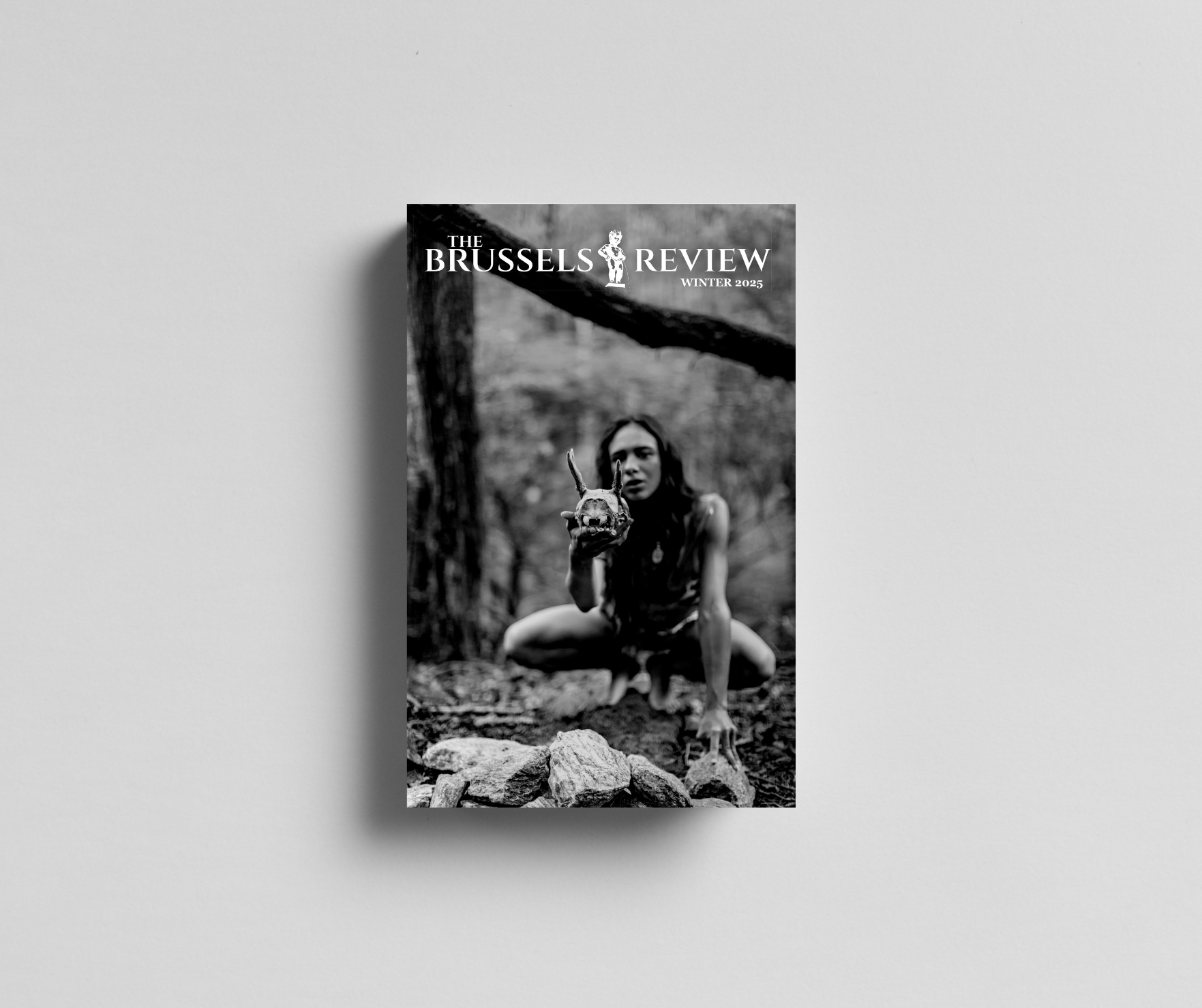
The issue is accompanied by black-and-white photographic works from Erlandson’s Ritual series. Set within wooded landscapes, the images stage the human body as a site of myth, vulnerability, and transformation. Drawing on archaic gesture and contemporary photographic discipline, the work resists narrative closure, instead invoking timelessness and embodied presence. Erlandson is a multidisciplinary artist-scholar trained in narrative, photography, and filmmaking, whose practice bridges ritual, visual storytelling, and performative stillness.
NONFICTION
Shena Cavallo, “Junk People”
In this expansive autobiographical essay, Cavallo examines working-class inheritance through the figure of the junk dealer; not as a metaphor, but as lived reality. Moving between Athens, Mexico City, and her childhood in the United States, she traces how poverty imprints the body, the senses, and one’s relationship to value itself. The essay resists romanticization while refusing shame, articulating the uneasy distance between economic escape and emotional fidelity to one’s origins. Cavallo’s prose is sociologically alert and personally unsparing, grounding abstract questions of class and dignity in physical memory and sound. Born in Oil City, Pennsylvania, and now living in Barcelona, Cavallo brings political awareness to intimate narrative without flattening either.
Cynthia Graae, “A Wedding Promise”
Graae’s essay unfolds around a seemingly modest domestic tension: a father-of-the-bride toast not yet written. From this point of anticipation, the piece expands into a meditation on marriage as a long negotiation between faith, habit, irritation, and grace. The narrative moves fluidly between humor and vulnerability, revealing how love persists not through clarity but through mutual endurance. With precise pacing and controlled wit, Graae captures the choreography of a long partnership on the brink of a public ritual. A widely published writer, Graae often writes from personal history; here, she transforms marital intimacy into a universal reflection on commitment.
Burcu Seyben, “Private Lessons”
Seyben’s essay is a rigorous and haunting account of childhood shaped by ambition, discipline, and unspoken danger. Centered on private tutoring and early independence, the narrative exposes how systems designed to produce success often cultivate silence and vulnerability instead. Seyben writes with lyrical restraint about authority, bodily autonomy, and the long shadow of formative trauma, ultimately reframing motherhood as an inherited vigilance rather than a corrective ideal. The essay refuses closure, allowing memory to remain unresolved yet intelligible. Seyben is an academic, playwright, director, and writer from Türkiye; her work bridges narrative, pedagogy, and ethical inquiry.
Dritan Kiçi, “The Dimensionality of the Character”
In this theoretical essay, Kiçi proposes a new framework for understanding literary character, rejecting the traditional flat/round hierarchy in favor of a four-dimensional model: identity, physicality, spirituality, and evolution. Drawing from literature, film, and myth, the essay argues that character depth is not a moral achievement but a functional design choice. Both practical and philosophical, the piece speaks to writers, critics, and editors concerned with proportion, restraint, and narrative ethics. Kiçi positions dimensionality as a method of deliberate withholding, asserting that presence in literature is often constructed through absence. Kiçi is a writer, editor, and publisher, and the Publishing Editor of The Brussels Review.
POETRY
C. Desirée Finley (Fin)
Finley’s poems move with elemental force, invoking wind, snow, and bodily sensation as sites of vulnerability and persistence. Her language oscillates between incantation and confession, allowing natural phenomena to mirror interior states without collapsing into symbolism. The poems resist control, embracing instability as a form of knowledge. Finley is a fiction writer, poet, and artist based in western Massachusetts, and an active member of several regional literary communities.
Greg Sendi
Sendi’s poems explore intimacy, doubt, and cultural dissonance through formally controlled yet tonally flexible verse. Moving between tenderness and irony, the work situates private relationships within a broader social unease, refusing sentimentality while preserving emotional risk. His poems often hinge on misalignment: between partners, between eras, and between expectation and reality. Sendi writes from Chicago and has been widely published and recognized.
Rip Underwood
Underwood’s poetry descends into language itself, examining how authority, history, and belief are constructed through words. His poems are reflective and measured, attentive to the moral weight carried by naming and narrative sanction. Drawing on historical and mythic registers, Underwood interrogates the origins of meaning without spectacle. He has owned a dental lab for many years and has devoted much of his adult life to poetry.
Sarah Dunphy-Lelii
Dunphy-Lelii’s poems attend closely to domestic spaces, memory, and emotional endurance. With restraint and clarity, her work allows quiet moments to accumulate significance, foregrounding observation over declaration and patience over resolution.
FICTION
The fiction of this issue is marked by narrative pressure rather than spectacle. These stories operate in zones of instability—ethical, psychological, technological, and ecological—where characters confront forces that exceed their agency. Rather than offering resolution, the fiction section privileges consequence, exposure, and the limits of control. Together, these works examine how individuals respond when belief systems falter, environments turn hostile, or inherited narratives no longer hold.
Corey Mertes, “The Doctrine of Signatures”
Mertes’ story draws on the historical idea that the natural world bears readable signs—marks that reveal hidden purpose or destiny. In this fiction, interpretive obsession becomes both method and danger. As the protagonist attempts to impose coherence on experience through symbolic logic, the narrative exposes the human need to believe that meaning is discoverable rather than contingent. Intellectual rigor and narrative unease move in parallel, producing a story that interrogates knowledge itself as a source of vulnerability.
Jon Filipek, “Here We Go Again”
Filipek presents repetition not as comic device but as existential condition. The story unfolds through cycles of recognition and denial, showing how characters reenact familiar patterns while insisting on novelty or escape. Memory functions less as guide than as trap, and momentum is generated by the tension between awareness and inertia. The result is a tightly controlled narrative that treats recurrence as a form of quiet determinism.
Laurence Klavan, “The Sleepwalker”
Klavan’s fiction inhabits the liminal space between consciousness and drift. The protagonist moves through the narrative with partial awareness, implicated in actions that feel both chosen and inevitable. The story’s dreamlike pacing mirrors this condition, allowing unease to accumulate gradually. Guilt, agency, and moral responsibility remain unresolved, reinforcing the sense that waking fully may be neither possible nor desirable.
Lia Tjokro, “The Caretaker of Tears”
Tjokro offers a restrained and emotionally exacting meditation on grief and care. The story centers on labor that is invisible yet essential—emotional maintenance performed without recognition or relief. Silence, repetition, and ritual structure the narrative, allowing sorrow to surface indirectly. Rather than dramatizing loss, the story examines how grief is managed, contained, and quietly endured.
Mary Burns, “The Corsaire’s Daughters”
Burns situates her narrative within a historical framework to explore inheritance, gender, and rebellion. The daughters at the center of the story negotiate freedom within structures designed to limit them, revealing how autonomy is both transmitted and denied across generations. The historical setting is not ornamental; it sharpens the ethical stakes by foregrounding constraint as a lived condition rather than an abstract idea.
Kevin Joseph Reigle, “Zebulon Burning”
Reigle’s story is driven by landscape and inevitability. Place exerts pressure on character, shaping action through environmental and social forces that feel irreversible. Fire functions as both literal and symbolic agent, marking destruction as process rather than event. Lyric intensity and narrative propulsion remain in constant tension, reinforcing the sense that endurance often replaces resolution.
Lydia Renfro, “Greetings From”
Renfro’s fiction is structured around distance—geographical, emotional, and linguistic. Fragmented communication becomes the primary narrative device, exposing misrecognition and longing through what is omitted as much as what is said. The story resists linear development, instead assembling meaning through absence and delay.
Shanti Ariker, “Fungal Vengeance in the Bro-Verse”
Ariker deploys speculative satire to dismantle contemporary masculine mythologies. Drawing on ecological imagery and genre exaggeration, the story exposes cultural decay through biological metaphor. Humor and critique operate simultaneously, allowing the narrative to confront aggression, entitlement, and collapse without moralizing.
Victor McConnell, “Machines Don’t Whimper”
McConnell interrogates technological agency and emotional absence in a world where response has been automated and empathy externalized. The story resists easy futurism, focusing instead on ethical residue: what is lost when feeling becomes optional or simulated. Humanity is measured not by intelligence but by the capacity for discomfort.
Ross McQueen, “Voice in the Storm”
McQueen closes the fiction section with a narrative driven by urgency and elemental threat. Voice functions as both anchor and liability, shaping perception under extreme conditions. As external forces intensify, the story questions whether articulation itself can offer stability, or whether it merely exposes fragility.