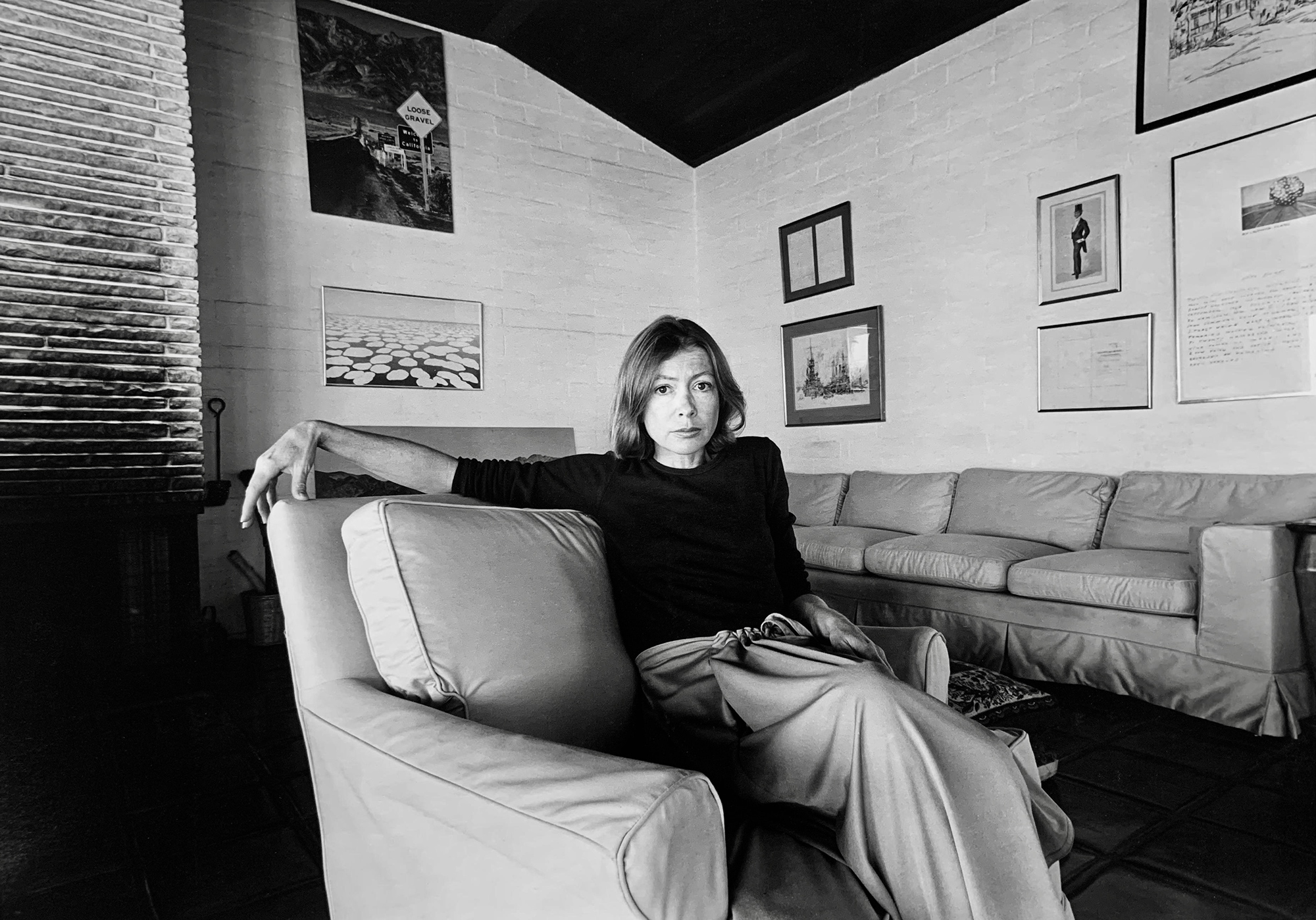
From recounting the decade-defining Tate-Labianca murders—the day the ‘60s ‘officially’ ended—to reckoning with the inherited trauma of her Donner party ancestors (The White Album); to detailing the struggles of losing her husband, John Dunne, and daughter, Quintana Roo (The Year of Magical Thinking, and Blue Nights, respectively), counterculture writer and essayist Joan Didion was never one for denying readers access to her innermost thoughts and feelings. She was, after all, a journalist, a writer, a documentarian of all things California. Yet her posthumous publication, Notes to John (Knopf, 2025), hailing from the Didion/Dunne archive at the New York Public Library, curated by surviving family, feels like a crossing of boundaries; an intrusion too personal, too intimate. And although the collection contains references Didion would later pen about in Blue Nights, as a whole it is a piece of writing I can’t help but feel she never intended to publish—at least not as it appears in this collection. A side of Didion we may have never been meant to see, it’s an exercise in weighing the desire to know more about Didion on a personal level with the inclination to allow her a modicum of privacy in an otherwise very public life. In short, by the end I was left confronting information I was not sure what to do with, information that was difficult to put into perspective with the Didion I thought I knew.
‘Re not taking Zoloft,’ begins Notes to John, a series of letters Didion penned to Dunne detailing her sessions with psychiatrist Roger MacKinnon. The letters begin on December 29, 1999, after weeks of initial visits, and conclude on January 9, 2003 with a recap of a session between Didion, Dunne, and Quintana Roo and her psychiatrist, Dr. Kass. And sandwiched in between are some of Didion’s most intimate fears (that Quintana may harm herself; that she raised her daughter to be dependent on her and thus unable to care for herself), struggles & insecurities (her perceived failures of motherhood, retrospectively reflecting on some questionable decisions she made, such as allowing Quintana to watch Jaws, an ‘Night of the Living Dead,’ at a young age, while Dr. MacKinnon judges her on those choices.; the difficulty forming bonds with Quintana. When asked by MacKinnon if she would have done anything differently in regards to allowing Quintana to watch ‘Night of the Living Dead’ at seven years old, Didion contemplates before responding that not allowing her daughter to watch it ‘didn’t seem like being a fun mom;’ the difficulty of forming bonds with her own mother; uncertainties in how to confront/help Quintana with her chronic alcoholism, and how much of that alcoholism was nature, via Quintana’s birth family, or nurture, growing up with parents who drank as heavily as Didion and Dunne. ‘She did see me every night at home having a drink,’ Didion tells MacKinnon. ‘I said it was particularly important to me when I was working.’ Didion often seeks advice on how best help Quintana but is met with harsh judgements of Quintana from a man who most likely never even met her and only knew of her through sessions with Didion and consultations with Dr. Kass), and a double Freudian spelunking into dream analysis and repressed childhood traumas that, according to MacKinnon, still plagued Didion to the present moment (her father’s enlistment in WWII and the subsequent change in his personality upon his return, and the almost-divorce of her parents, for example).
According to the editor, the 150 pages of letters was located on a file which also contained content Didion would later share (the notes from her doorman the night of John Dunne’s death; the speech Didion gave at Quintana’s wedding). The final session with Quintana, though, was stored separately on her computer (I’ll come back to that). However, the same file which contained the letters also included hotel reservation information as well as personal passwords—and it is those final two items in particular that lead me to argue that these letters were never supposed to be read by a public audience in their original form. Further, the copy of the speech was a draft, not the final product, lending even more evidence that this was a folder of personal information of which some would later be published but the majority was intended solely for Dunne’s and Didion’s eyes. Didion often makes brief references to conversations between her and Dunne, with no follow-up elaboration on what those conversations detailed, thus providing further proof that these notes weren’t meant for publication (‘I said that you and I talked at length about what [Dr. MacKinnon] had said’). Additionally, the editor inserts footnotes every so often to provide context for people and events Didion discusses, as Didion herself, again, does not elaborate. Why would she, if these letters were meant solely for herself and John? If using the name ‘Robert’ but not detailing who Robert is, or what their relationship entails, is that not a sign that there wasn’t meant to be an additional reader who would need more contest? Whether or not she intended to use the material in future essays or collections, surely she would have wanted to edit it first, to tell the story in an order of her choosing. To reflect on the sessions versus merely recap them almost word-for-word.
The style of Notes is more informal documentation vs narrative-focused, coming across as notes one jots down so as not to forget them vs the makings of a future manuscript. This is also in line with a passing reference made by MacKinnon about the need to write things down as well as discuss them, in order to best remember them (‘They’re the same tricks you use when you’re learning to study,’ MacKinnon explains. ‘You hear it or read it, then you repeat it to yourself…then you write it down’). It follows a back and forth exchange of Dr. MacKinnon said this; I said that. There’s no narration, just transcribed therapy sessions. It’s a format that only lends more credence that the notes were purely for documentation purposes vs public consumption:
I said our discussion last week had made me think a great deal about how Quintana might as a young child have perceived us. I said I had seen a parallel to what Dr. MacKinnon had pointed out to me about the unspoken message—my father’s depression, his suicidal thinking, my mother’s reaction to it—I myself had picked up on as a child…it seemed to me entirely possible that Quintana had picked up tensions in our own household… [that she] may well have read them as potentially disastrous.
‘Exactly. She knew she was adopted, she had these parents who had adopted her and loved her, but what would happen to her if something happened to them? I think you’ll find that as she comes to realize how strong you really are, she’ll begin seeing that this childhood reading was a bogeyman, a scary figment of her imagination.’
I said I knew she had always thought of me as fragile.
It’s a style far removed from Didion’s renowned prose, a lot less Slouching Toward Bethlehem and a lot more ‘to do’ list. It’s clear her ‘voice’ is still there, lingering on the outskirts of diary-like entries, but that quintessential Didion panache is missing. I of course could never presume to know what Didion intended, but if she felt any protective instinct with her writing then I can surmise that she had no intention to rework these notes into a single manuscript. Perhaps she used them as references when writing Blue Nights, and Magical Thinking, but, as a whole, the notes appear to remain precisely that—a reference point, an outline, for later compositions. Something she could return to and pick and choose from when working on future writings.
This collection, to me, feels Iike an invasion of privacy, positioning the reader as the proverbial fly-on-the-wall eavesdropping on someone’s most intimate moments. There were many times where I found myself damn near ready to apologize to Didion for walking in and overhearing something not meant for my ears. Didion comes across as frail, vulnerable. It’s in complete opposition to the small-but-mighty powerhouse persona she cultivated. There were moments where my levels of discomfort wavered. In several sessions MacKinnon relays specifics of Quintana’s discussions with her own psychiatrist, Dr. Kass. I found it off-putting, leaving me questioning the ethics of the situation (are psychiatrists allowed to share the specifics of another patient’s sessions with their own patient? I’m no HIPAA-literate expert, but this feels like a borderline violation. They are family, but Quintana was also a grown woman and entitled to her own levels of privacy). Unless this was family therapy, which isn’t made clear in the collection aside from the session Didion and Dunne attend together with Quintana and Dr. Kass, it seems incredibly intrusive. As hinted above, this joint session with the whole family was kept separate from the rest of the 150 pages of letters. There’s no indication as to why but, based on the overt hostility between Didion and her daughter in the session (it’s quite palpable on the page. ‘I said I didn’t know where this hostility was coming from,’ Didion recounts. ‘I was trying to keep her alive. Because she was killing herself day by day’). It’s clear the relationship was fractured, rupturing at the already worn seams struggling to hold it together) it’s something Didion perhaps filed away separately after Quintana’s death. When cataloguing the session Didion describes Quintana as speaking with ‘[the] familiar drunk ramble about how much she hates New York about how everybody is always on her back.’ A moment that may have provoked deep shame or regret, but was still something she meant to hold onto. Just for herself. Didion appears to reroute the emphasis back on herself in what she must have thought were the genuine concerns of a loving mother but with Dr. Kass perceived otherwise:
I said I had told her that I couldn’t stand by and watch her [slowly kill herself with alcohol]. Because it would kill me as well.
Dr. Kass said he didn’t think that was a helpful thing to lay on her.
Let me make it clear that this is in no way any slight against Didion; I am and always have been a massive fan. Her prose is legendary, unmatched. I confess wishing many times I could get a glimpse inside her head, poke around the inner mechanisms of her mind and understand her process; how she writes, how she formulates her ideas. But now that I’ve had that opportunity, I feel uncomfortable, an invader inserting themselves where they aren’t wanted. Yet, despite the intrusion, Notes to John is a must-read for all Didion fans. It gives us an all-access glimpse into Didion the person, and all the frailties and doubts it entails. I am not sure if we will ever know for certain what Didion’s plans were for these notes, if any, although I can say with a good amount of confidence that it wasn’t this. Maybe we aren’t meant to know what her exact plans were (it is intriguing, alluring, when a writer of such caliber still maintains an air of mystery. That as much as we claim to know about them, there are still things we don’t know. Which only adds to the lore, a cult of personality of sorts). What is certain, though, is that the letters do not fit in with her most well-known works, functioning as an outlier in an otherwise prolific body of writing. It’s rough around the edges, unedited, devoid of that Didionesque style. And while vulnerability is something Didion has shown us before, it has always been a vulnerability she maintained control of through prose. Yet here we see Didion documenting a vulnerability laid bare by others, with no omissions, no re-writes; no retractions. It’s an insight far too exposed, and one that shatters the prevailing mythology of the Didion we’ve constructed in our minds and instead allows us to see her as she truly was—fragile, insecure, deeply human.
* Notes to John, by Joan Didion, Knopf, 2025