
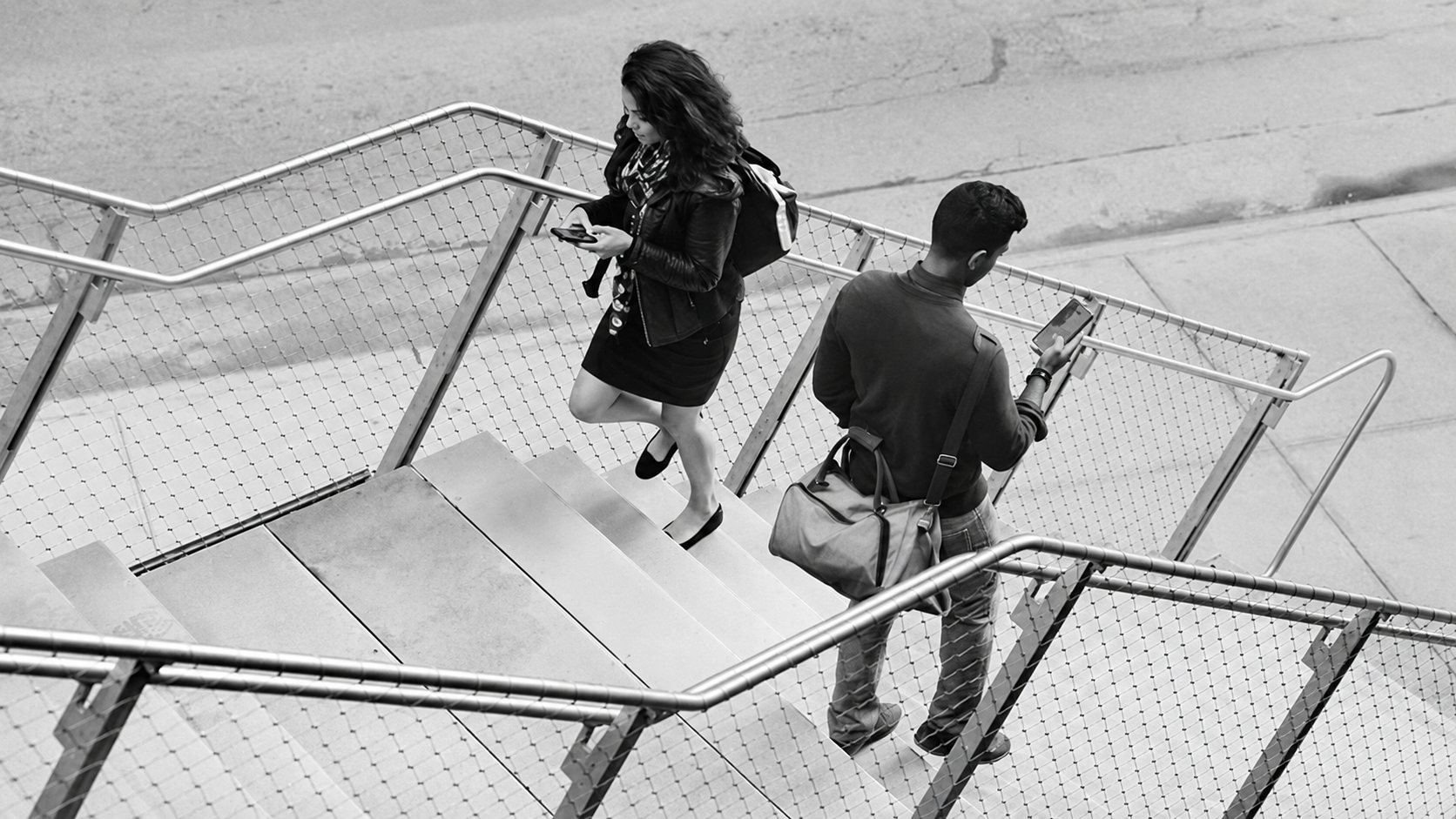
Different, logically independent arguments (except for the last) converge on the same conclusion: that you shouldn’t walk down the sidewalk looking at your phone. The more cognitively demanding task of texting while walking, as opposed to swiping, swerving, beaching, in any case distracting tasks, is more specifically the target of these arguments; especially as texting is often the foremost reason one is looking down at one’s device (meaning that one would not have looked down had not one been texting). I wouldn’t fault someone for checking their watch, provided they aren’t hypnotizing themselves with it (anything can happen in a largish city like New Haven).
The first is that you could easily fall to harm because distracted. Each time your eyes flit briefly upward they make a mockery of the many narrowly-avoided sea-faring crashes that must have occurred in the heyday of 19th century shipping yards, which required constant vigilance from sea-faring foremen to prevent spillage of their wares. God forbid you are hit by a bus and the human population is thinned out by some miniscule degree. On the other hand, looking down all the time makes you an easy target for what has not so affectionately been called ‘the male gaze’, should you welcome it.
The second is that it is part of being a citizen of a given town or city, that you maintain a basic level of awareness of your environment, of your fellow citizens. Just as you would expect someone to intervene or alert the authorities if you were assaulted on the street, as opposed to that person being distracted by their device, so should you be in a position to aid others if the situation arises. And since it can easily arise, especially in medium to large sized cities where crime rates are higher, and being on your device is liable to distract you, sapping crucial good Samaritan response time, then at the very least it follows that you have an obligation qua citizen to not spend the entire duration of a given walk on your devices. I leave it open just how much it is required to not be distracted by the device.
The third is bugs. Think how many bugs you have already squashed as you walk down the sidewalk, because looking down at your device and not having an extra pair of eyes, you fail to notice them. Now this is not to say that a person should spend all their time looking down at insects on the sidewalk while walking. I counted about six just today. (Often lantern flies, squished with the excuse that would punish an individual because of the crimes of species). Yet even if you don’t bear in mind obvious seasonal patterns of insect traffic, the occasional glance is not only warranted, but arguably morally required, at least if we think that non-human lives count for more than ‘likes’ on your social media accounts. Peter ‘The Undefinable’ Singer, proposed a principle that is apt here, to paraphrase: ‘If you can prevent a significant moral harm by not sacrificing anything of comparable moral worth, you should do so’. I submit that it’s a moral harm to kill an ant because you happen to be addicted to your device, not like low-key ‘I like a packet of sugar in my coffee addicted’, but glued to it like it’s syrup, glycerin addicted. ‘Ah, but I really like it, I’m used to it, Amazon and Facebook and other conglomerates have conditioned me to it’ is no excuse. Or, it is an excuse, but it’s rather like the wealthy Roman senator who says at a festival where pheasants are being roasted alive: ‘but I couldn’t live without the Emperor’s parties!’, for the writhing of a stink bug or ant in the sun after you have half-stepped on it, squishing its guts out, wings still flapping, is not much different than this throwback to antiquity. ‘Then should I not drive because the bugs will squished onto my windshield?’ But that is inevitable if you drive; it’s not inevitable if you are walking that there be such casualties, carousing from one bar to the next, on your way to the library, or whatever, as precisely the point at issue is whether you are choosing to allow insects to die. It may be that the choice is made on the basis of devaluing the lives of insects relative to human lives, but that, too, is a choice you’ve made, and perhaps one that you’re complicit in when you can’t even for an instant check your surroundings as you walk (or bike, even) to your destination.
The fourth is mindfulness. The world as it is represented to you by your naïve senses, unmitigated by your devices whose screens feature content carefully keyed to your preferences, is a lovely, full, place. You know this. It is a place of incredibly vivid detail—as vivid as you would allow your senses to make it. When you stop to look, you might see that yesterday’s storm took down a bird’s nest but the egg in it is intact. You might taste something of Fall’s first breezes as they rustle up last season’s leaves which curl around the odd cup’s crinkled rump or wrapper—how far someone must have driven to even find a Chuck E. Cheese, then wantonly litter the cup—you might see how just one single waffle fry from a diner escaped a gaping maw as one hand scrolled and the other grabbed for more in the flimsy red and white basket, fallen past the limit of the five-second rule. You might even see another human being walking on the sidewalk, one who understands that it is designed for there to be two opposing paths, each occupied by a different individual, rather than there being only one path which is staggered as if drunkenly, though quite naturally, towards the center so as not to stray onto the grass, by someone looking down at their phone. Maybe ‘drunkenly’ is not quite right; tottering, looking down, like an infant whose belly is full of the milk of promises, promises vitamin rich, breastfed by corporate oligarchs, a future that will never arrive in their lifetime, a kind of complacent contentedness that is not even smug enough for the potential to realize its folly, booming and untrained in sentiment. (If addiction is addiction, and not a way to be, is it so different, their looking down, as opposed to the Leaning Tower swaying fentanyl addict looking down?) That a person can be contented by the surprises that accompany them on a walk, even if these are constituted by the corresponding bodily sensations—how exactly does my stride feel, how does it appear, am I still sore and where—all of these experiences belong to oneself, one’s own unfiltered perception of the world that are damned the moment that you look down at your device. God forbid you say hello or make eye contact with anyone, or acknowledge a ‘Good Job’ from a stranger if you’ve climbed a steep path with an infant irresponsibly strapped to your chest.
I remember reading once about a different kind of experiment involving mediated perception. Humans and chimps (test subjects, not the kind that ripped your face off) were both outfitted with a kind of helmet that made them appear to see the world upside-down. Humans took some time to adjust to it, but eventually did. Chimps didn’t fare as well. Dress them in diapers, feed them from a bottle, let them rip your cheeks off, all skilled behaviors, they didn’t fare so well at this. And at the time scientists attributed the difference to the plasticity of the human brain. But it was, after all, an experiment. After it was over the brain would take time to rewire itself and for the world to appear normally again. Now that the younger generation, at the behest of the corporations who design your phones and create the software for your apps, has been subject to the social media experiment for so long, it is hard to say whether their minds can successfully rewire to having what I’m calling naïve, unmediated perceptions of the world. Yet perhaps hope that they can exists if these few arguments can still be rationally appreciated, as rational appreciation itself requires an act of attention which your capitalist overlords would gladly see you deprived of.
The fifth: consistency. ‘But look, this is old hat. I learned this complex skill of “walking” so long ago that I can do it in my sleep, I can add onto it any number of skills, texting, juggling, talking, dancing, stairs’. Yet this same argument most rational people would not make with respect to driving, and if you would, then driving where? At what speed? A hard-to-answer slippery slope arises. Obviously too, it shows such overconfidence from the perspective of the objector. Walking, as we should understand it, is a generalized skill that evolved over millions of years and in such a way that it admits some flexibilities, like walking while holding small objects, walking while chewing gum, walking while occasionally retracing one’s steps along a given path, looking back to see how the landscape might have shifted. None of these flexibilities implies a kind of separation from the mind of the walker and his limbs, where like Frankenstein the limbs go on while the mind is overseas looking at AI-generated profiles of Russian widows or the latest what-could-go-wrong type challenge, or those crazy parkour videos that seem to suspend gravity in the way that it is in fact never suspended when you place one foot in front of the other.
Sixth, phronesis. Back in the day, e.g. aka ancient Greece, phronesis meant a kind of overarching wisdom, the ability to balance one virtue against another, or see how it outweighed some tempting vice in making a tough decision. To have the patience to understand when courage is appropriate or foolish; to be courageous enough to know that patience comes to an end. If any of the preceding arguments have been found convincing, then, if you are tempted to bring out your phone to look down at it after being conditioned to the charming ‘ping’ sound, you should ask yourself: ‘Is this important?’ or ‘How important can this be?’ I think in most cases you’ll realize that it is not likely to be more important than one or more of the above arguments, so that, again, the wise move is to just keep walking and check the message later. Your elders who understand the relative position of their body with respect to others in space will thank you for it. Your peers in the market will thank you when they avoid the collision between their shoulders and the display of Dorito bags.


