One can rightly say: what the heck is this title; the stories are about people and characters?!
Bear with me. Prose is not about characters; it is about what happens to them and how one tells it.
The weakest prose tends to place the character at the center of every sentence, while the stronger, beautiful narration is focused on action. One can ask: what about self-discovery writing; there is little action in it. For the purpose of narration, even the mental acrobatics of a character are action.
There is a simple way to recognize what I’m talking about. The most central labels in language are pronouns: I, he, she, it, they, we. A pronoun encompasses an entire character in a single syllable. It points toward the entity without telling us anything about it, and because of their commonality, they tend to become invisible. Readers glide over them without noticing. Writers do the same. This invisibility allows weak writing to hide in plain sight.
Consider a simple test. Replace every pronoun in a passage with the character’s name.
John entered the room. John sat down. John looked at Mary. John wondered why Mary was silent.
The repetition becomes unbearable. Yet the original version may appear perfectly acceptable:
He entered the room. He sat down. He looked at her. He wondered why she was silent.
The pronouns conceal the weakness, but they do not remove it.
Another similar test reveals the same problem at a larger scale. Count how many paragraphs begin with a pronoun.
He walked to the window…
She watched from across the street and…
They waited for the signal, before…
He checked his watch again and…
Nothing is grammatically wrong. Yet each paragraph announces the same priority: the character comes first. The eye encounters a person before it encounters an event.
Now compare:
Rain hammered the window…
Across the street, a figure remained motionless, as…
The signal never arrived.
Minutes slipped past and…
The people are still present, but the paragraphs are driven by happenings rather than by references to who is present.
This leads to a useful analytical tool:
When reviewing a passage, ask where the weight of the sentence resides. Does it reside in the character, or in the action?
Weak prose answers the question: Who is present?
Better prose answers: What is happening?
The distinction is subtle but important, and all of this has another side effect: pronoun-led sentences tend to fall on weak verbs, while action-focused sentences give the writer the liberty to explore stronger verbs intuitively.
He was angry.
The sentence identifies a state.
The drawer slammed shut.
The sentence reveals the same state through action.
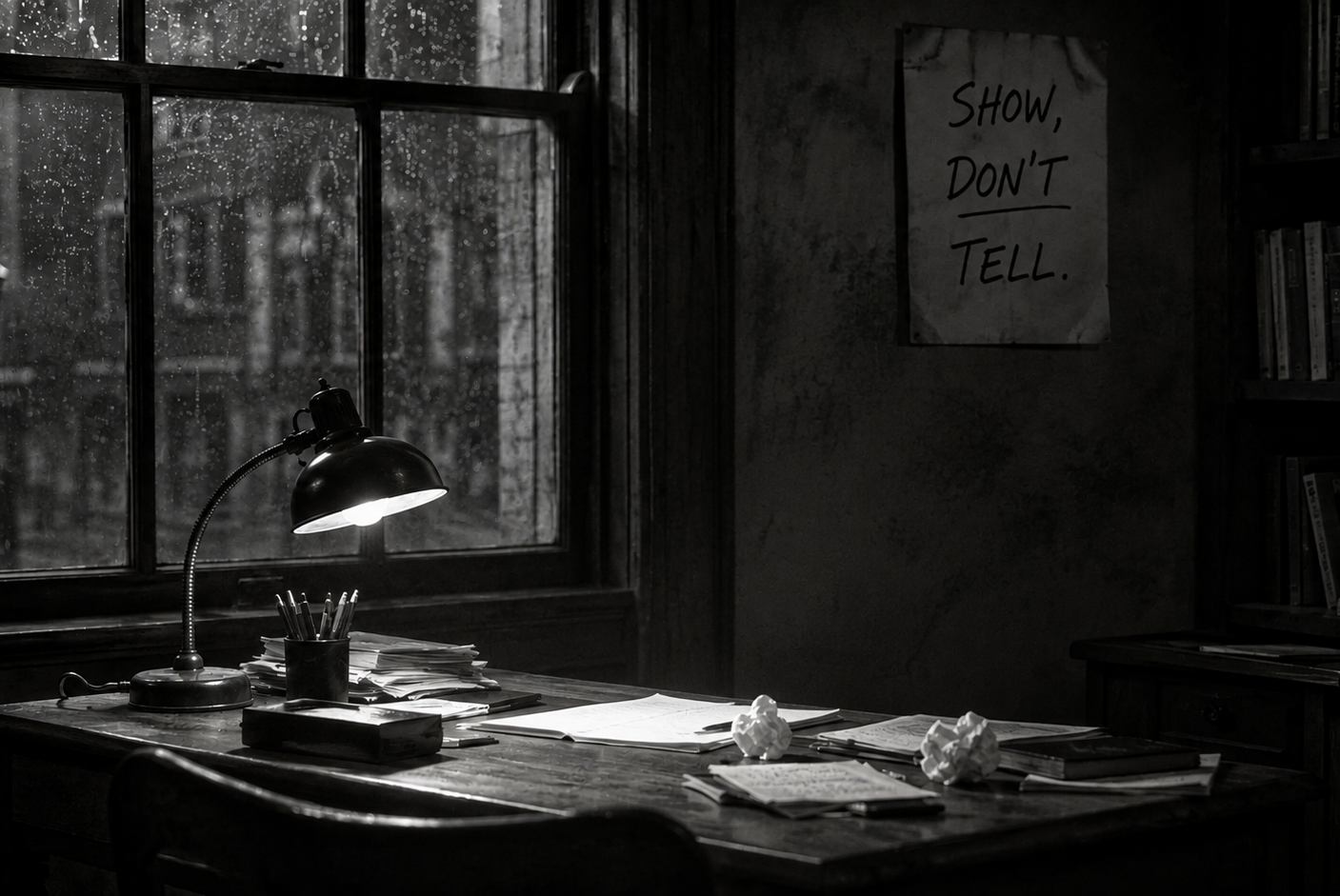
The first sentence makes sense of the character. The second makes sense of the event. This is the ABC of show, don’t tell, of course, but what we have explored till now gives the writer a self-check mechanism.
Languages such as Albanian make this principle easier to see. In Albanian, Italian, Spanish, Portuguese, Greek, Turkish, the Slavic languages, Arabic and Hebrew, the verb often carries the subject within itself. Pronouns are frequently omitted because they add little information or stylistic value. English cannot function in the same way; its grammar requires explicit subjects. Yet the underlying lesson remains valid: The energy of the sentence should reside in the verb, not in the pronoun.
This is not an argument against pronouns; it pushes against allowing them to carry the narrative. Pronouns are structural necessities, but verbs are narrative indispensabilities.
So, when you edit your writing:
- Highlight every pronoun in a paragraph.
- Then highlight every verb.
- If the paragraph survives because of its pronouns, it is descriptive prose, and if it survives because of the verbs, it is narrative.
Another useful exercise, as we saw in the examples, is to scan the starting word of every paragraph. A page dominated by he, she, they, or we often reveals a deeper habit: the narrative keeps reintroducing characters instead of advancing events. The pronoun becomes a crutch, quietly occupying the position where something more interesting should stand.
Don’t misunderstand, the goal is not to remove the character from the story, just from the center of the sentence. The reader knows who is acting; you just introduce it once and there is no need to mention it until another character enters the scene, or when syntax requires you to use a pronoun.
Readers don’t remember pronouns. They remember actions.
So, the character should be present not because the text repeatedly points at them, but because the text shows them acting upon the world and being influenced by it.
I must confess: Because of all this, I hate pronouns; they are lazy.