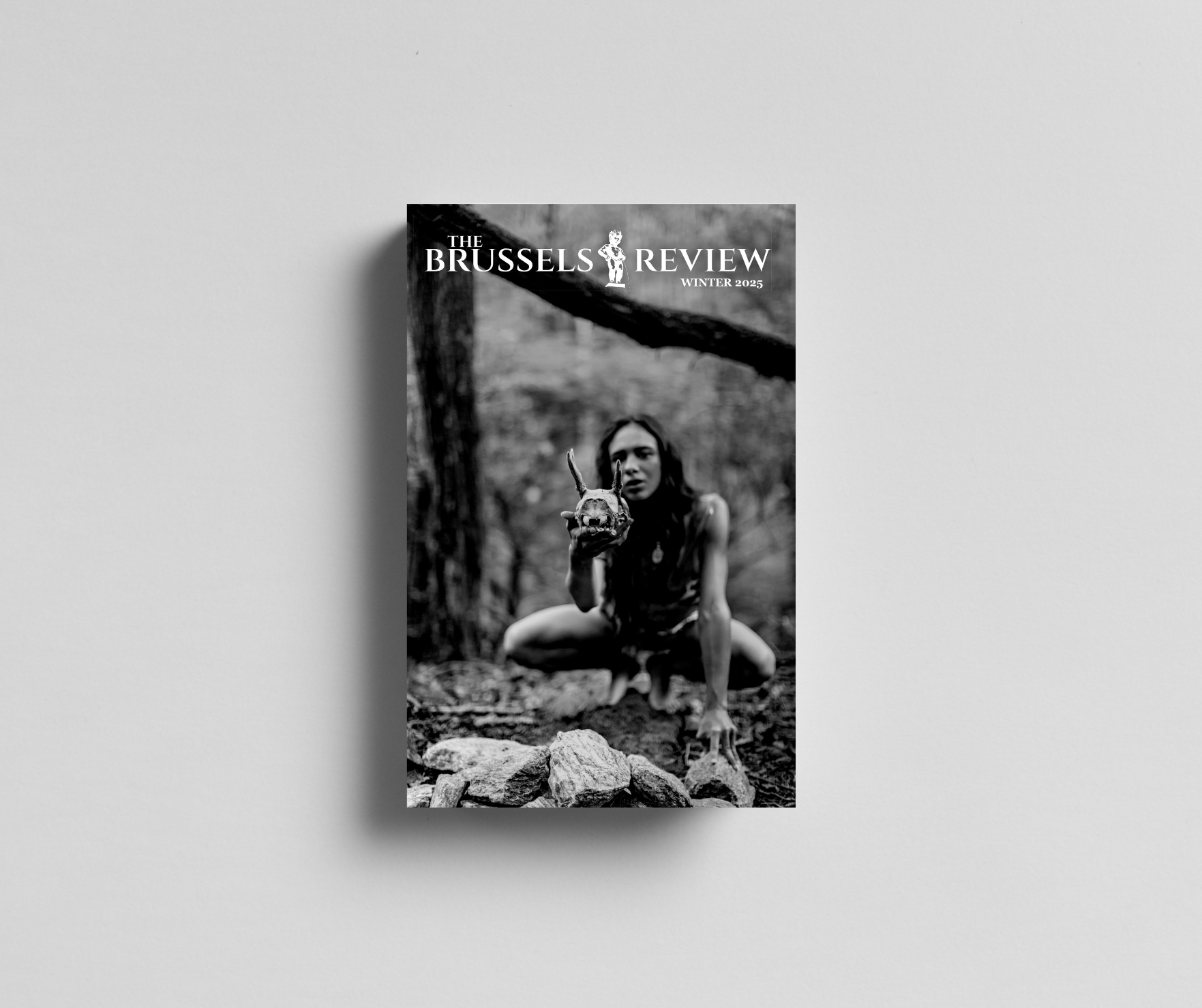
In this episode of Call to the Editor, fiction editor Femke van Son speaks with writer Laurence Klavan about his short story The Sleepwalker, published in the Winter 2025 issue of The Brussels Review. The conversation explores the story’s dystopian setting, its use of artificial intelligence as a tool of dehumanization, and Klavan’s deliberate engagement with older narrative forms such as soap opera, noir, and classical melodrama. Klavan reflects on his writing process, the transformation of longer works into shorter forms, and the tension between human intimacy and technological abstraction. The interview concludes with a broader discussion of artistic discipline, publishing cultures in Europe and the United States, and the importance of valuing the act of writing itself over commercial outcome.
Femke van Son: Hello and welcome to this episode of Call to the Editor. My name is Femke van Son. I am a fiction editor with The Brussels Review, and I am here today with Laurence Klavan to talk about his story, The Sleepwalker, which is featured in our Winter 2025 issue of The Brussels Review. You can get the Winter 2025 issue at shop.thebrusselsreview.com. Use the code Calltotheeditor to get twenty-five percent off until the end of January. I would also like to thank our sponsor, the ACC, the Art and Creativity Consortium, the organization that supports publication of The Brussels Review and its wider cultural initiatives across Europe. If you are a creator, a writer, a small editor, a small publisher, or an organization dedicated to supporting the arts, you can connect with them and visit ArtCreCon.org to learn more and become a part of the cultural network. So let’s get started. It’s lovely to have you today, Laurence.
Laurence Klavan: It’s great to be here. Thanks.
Femke van Son: Can you tell me a bit more about yourself, where you’re based, and what occupies you on most days?
Laurence Klavan: I am a writer living in New York City, which I’ve been doing for a long time. I spend my time writing in all kinds of forms. I started out in the theater and then moved on to fiction. I’ve written mystery novels and short story collections and graphic novels and musicals and one-act plays and all kinds of things. I spend as much time as I can doing that. I used to work in publishing; that was my gig for a long time. But at the moment I’m just freelancing my work. I do it every day, and I’m hoping to do it today and tomorrow as well.
Femke van Son: That’s lovely to hear, that you’re spending so much time writing. It’s often hard to find that time. I understand that myself, so I really enjoy hearing that you’ve devoted your life to doing that.
Laurence Klavan: Yeah, I’ve always enjoyed it. It’s kind of corny, but I always tell myself that writing a book is like reading a book very slowly. You’re doing it to entertain yourself. And sometimes you can entertain yourself more than other people can. I think that’s one of the reasons I started doing it as a kid, being somewhat overwhelmed and also slightly bored by reality. I found it gave me a certain amount of control and power over events, but also just entertained me and distracted me. And the way the world’s going, distraction and entertainment is a public service.
Femke van Son: So have you been writing since you were a child then?
Laurence Klavan: Yeah. I guess around ten years old, maybe before that; I can’t remember anymore. I know I did writing on my bike a lot, again to distract myself. I started out being obsessed with movies, and then I kind of moved on to the writing part of things. But yes, I’ve done it since I was a kid.
Femke van Son: That’s lovely to hear, because that means you’ve had a lot of time to hone your craft and really get adjusted to your writing. So I want to talk a little bit about your story The Sleepwalker. I really enjoyed the dystopian future you created, where AI is used to essentially strip a woman of her human identity and literally objectify her.
Can you elaborate on how you came to the idea of Brenda and her complicated relationship to Luna Haze?
Laurence Klavan: I don’t know how much of the story I should tell, but I’ll just talk, assuming that’s no problem. I often approach things with a futuristic or fantastical bent to distort things for myself. I’m also very interested in old movie genres—horror, noir, things like that. In this case, I was coming at it from a soap opera, what used to be called “women’s pictures.” Often the subject was the shocking past of a respectable woman and how it comes back to haunt her. There was a director, Douglas Sirk, who did Written on the Wind, Imitation of Life, and all these hysterical soap operas about the suburbs. I was thinking: if you use that model and apply it to a futuristic, industrial world—where identities and sexuality are turned into something literally robotic—what happens? So the idea was this detached young suburban matron whose daughter is being married. On that day she is recognized as the face of a robotic escort she once modeled for when she needed money. A workman recognizes her in her own house, and that disrupts her life, her knowledge of herself, and her relationships with her husband and daughter. I was working from an old template to do something present and future. I do think AI is taking over a lot of this, and I’m as horrified by it as anyone else. What I try to do is express a traditional, classical human story using the details of an increasingly non-human existence. You could call it an over-age coming-of-age story: a woman finding herself again through these genres, reworked in a modern and futuristic way.
Femke van Son: That’s a really creative way to approach it. It works with the idea of cycles—things repeating themselves in new forms. I really like your point about it being a coming-of-age story for someone already an adult. Especially toward the end, where she reclaims control over her identity and sexuality.
Laurence Klavan: Without spoiling it, the sex scene was an attempt to do something messy, human, fleshy—hopefully erotic—to explode the industrialized male fantasy of the escort robot and turn it back into something human. I deliberately delayed that scene until the middle of the story. You lure the audience in and then spring it on them. She reclaims her agency, and it alters her relationship with her daughter, with her controlling and somewhat violent husband, and changes the rest of her life.
Femke van Son: Is there a particular moment from the piece that captures what you were trying to say?
Laurence Klavan: Two moments. One is the interaction with the workman, where she takes control in a very aggressive way. The other is a flashback to how she originally became the face of the escort robot. It’s structured like an old courtship scene from a novel or film: a working-class girl visited by a rich man, a desperate mother pushing the match. Except he’s really there for the robot, not her—he sees her as a possession. Using that early twentieth-century courtship model refracted through AI and class felt important to me.
Femke van Son: Those were the moments that stood out to me as well. What is your writing process like? Do you plan everything, or do you discover it as you go?
Laurence Klavan: I always outline. I came from theater, so I think in three acts. Beginning, middle, end. That gives me direction. As I write, things change, but I never start with a blank page. Even with flash fiction, I outline those beats. Structure gives you freedom within it. I try to work every day. I see myself as the boss of a somewhat impoverished company, and I take control of it.
Femke van Son: Were there any moments in The Sleepwalker that came spontaneously?
Laurence Klavan: The ending, with the fisherman who finds the discarded escort robot underwater—that may not have been in the original plan. He uses it as a companion after his wife dies; the dying battery becomes like a human heart. The story was originally chiseled out of a longer, unfinished novel about the whole family. I became interested in the mother’s story and focused entirely on that.
Femke van Son: Where was the longer version going?
Laurence Klavan: The novel was called Save the Date. It centered on a decaying suburb and a disgraced father throwing a party after returning from jail. In that version, the mother had killed herself, and her past as a robot model would be revealed later. I dismantled the novel into pieces. The daughter’s story became a novella, The Flying Dutchman, coming out in January from Regal House. Sometimes I have more luck with shorter work.
Femke van Son: What do you hope readers carry with them after reading The Sleepwalker?
Laurence Klavan: I hope they’re pulled in by a conventional dramatic structure—the wedding day, the family—and then find themselves somewhere unexpected. Using old forms in a new setting. Being lured in and coming out changed.
Femke van Son: What’s next for you?
Laurence Klavan: A story collection, Adult Children, just came out from Cornerstone Press at the University of Wisconsin–Stevens Point. The Flying Dutchman comes out in January. I’ve just finished a mystery-style novel draft, inspired by Patricia Highsmith. I’m also writing plays again and have a one-act draft. I try to stay busy.
Femke van Son: That dedication really shows.
Laurence Klavan: You have to prize the act of doing the work more than publication. Especially in the arts, you can get jerked around. One of the things I appreciate about being published in Europe is the value placed on pure artistry and on forms like novellas. Detaching from commercial obsession often improves the work.
Femke van Son: That aligns perfectly with our mission at The Brussels Review. Thank you so much for this interview. Readers can find The Sleepwalker in our Winter 2025 issue. And thank you again to our sponsor and to Laurence Klavan for joining me.
Laurence Klavan: Thank you. I really appreciate it.
Femke van Son: Until next time.