Every year for as long as he could remember, Dickran attended the commemoration of the Armenian genocide on April 24th in Deir ez-Zor in the heart of the Syrian Desert. He first attended at age two, and currently he was 32. Up until he was twenty, he attended the commemorations with his parents.
While at college in The Netherlands, where he studied architecture, Dickran flew home each year to Aleppo in order to join his immediate family for the commemoration. Upon graduating from the University of Amsterdam, he returned home, moved into his own apartment and joined one of the most prestigious architectural firms in Aleppo. From that point forward, he began driving himself to the commemorations since he often had to return to work following the three consecutive primary commemorative services (one along the Euphrates River, one at a small chapel perched on a stony hillside in the desert west of Deir ez-Zor, and one at the Armenian Genocide Martyrs’ Memorial, which also housed the Museum of Lost Objects in its basement).
Everything changed, though, when the Syrian Civil War broke out on March 15, 2011, as a result of pro-democracy protests (many Syrians were extremely unhappy, if not enraged, over the high levels of unemployment, widespread corruption and lack of political freedom) that had swept all across Syria during the Arab Spring, threatening the rule of Syrian President Bashar al-Bashar. No matter where one lived in Syria, it was dangerous as government troops pounded towns and villages where it believed the opposition was at work and rebels attacked government troops and military installations in an attempt to overthrow the dictatorship.
Between 2011 and 2014 missiles had destroyed parts of the Armenian Martyrs’ Memorial Church in Deir ez-Zor church made it all but impossible to make it from Aleppo to Deir ez-Zor and back without getting killed by one faction or another in the civil war that was literally tearing the nation apart. It was still standing when, in November 2014, ISIS[i] utterly destroyed and desecrated it.
Life in Aleppo (which, prior to the civil war, had been graced with wondrous architecture, whose styles had been conceived by those who had ruled it over the centuries, including Romans, Byzantines, Mamluks and Ottomans, among others) had quickly become untenable for most, as rockets and war planes pounded it into mountainous heaps of crushed concrete, curled rebar, and glass shards as one building after another – homes, high rise business buildings, schools, churches, mosques, ancient marketplaces, and revered ruins from the ancient past — tumbled into extinction. “Aleppo,” British U.N. ambassador Matthew Rycroft observed, had relatively quickly “gone from siege to slaughter.”
The Old City of Aleppo, a veritable jewel of ancient buildings, including 13th and 14th centuries constructions, such as Quranic schools, caravanserais, hammams, caeserias, and various religious edifices, had also suffered terrible destruction. Some buildings were badly damaged, while others had been pulverized. Where walls still stood many were bullet-pocked.
Periodically, while having drinks after work, one of the other of Dickran’s colleagues took a stab at black humor: “Thank goodness for Uncle Assad[ii]2. While he’s bombing everyone else into oblivion, he’s clearing the way for us to completely design and build a new Aleppo. He’s gonna make us riiiiich!” Sometimes the humor would bomb, sometimes it wouldn’t. It was contingent on how inebriated Dickran and his friends were and/or the catastrophic nature of a recent bombing. Dickran, for the most part, found the “jokes” tasteless.
When the Syrian war broke out in 2011, Dickran’s family fled from Syria to Lebanon and then to Italy, where they had family. Dickran remained in Aleppo, eventually joining the White Helmets[iii]3, the organization composed of courageous volunteers who were nearly always among the first on the scene of a terrible explosion that caused buildings to fold like the proverbial house of cards. For eight months he worked with the White Helmets, digging around and under giant chunks of concrete, smashed walls, caved in roofs, and destroyed furniture in search of survivors, and then immediately attending to their medical needs before the victims were raced to a medical clinic. Numerous times he saw fellow White Helmets shot by snipers and keel over dead as they fought to save others’ lives.
When April came around, five years into the war, Dickran had a plan, and nothing was going to stop him from putting it into action — certainly not fear as he had already experienced plenty of that from the aerial attacks on Aleppo and sniper’s bullets taking out unsuspecting victims.
On the 3rd of April, he announced that he was leaving the White Helmets. When his fellow volunteers asked where he was going, he simply said, “Out there” pointing to the west. When they asked him why, he simply said, “It’s time to rebuild.”
II
Early the next morning, Dickran located a long-distance Mercedes taxi that was heading to Deir ez-Zor, bargained over the price, paid, and got into the back seat next to two heavy set women in abayas and niqabs. Once the taxi was full of passengers and all of their goods had either been put in the boot or placed on the roof and tied down, the driver, a grizzled looking fellow with thick black whiskers flecked with gray and greasy black hair, streaked with gray, who never stopped smoking one cigarette after another, hopped in and pulled on to the road. The driver occasionally muttered something to himself, the cigarette between his lips slightly bouncing with each word. Occasionally, he pulled the cigarette from his mouth, tapped it against his steering wheel to rid it of ash, and went right back to puffing on it.
When the taxi edged out of the city limits, the driver floored it. The dun colored desert flashed by, as did civilians walking along the road, dumpy huts in which people lived with their animals, and aimless donkeys and the occasional camel ambling along the side of the road.
Each time the taxi approached a roadblock – those closest to Aleppo were manned by the rebels fighting Assad’s troops, those further out in the desert were manned by government troops — the taxi driver groaned loudly and then swore under his breath so that it was barely audible. When baksheesh was demanded of him, he, without a word, pulled out his wallet and handed over the requisite amount of cash. Once he was waved through, he spewed profanity a bit louder and with more vitriol.
Intent on making up for lost time, the driver pushed the taxi to its limit, racing through tiny villages that hugged each side of the road, barely missing those daring to cross as he sped by. He wove in and out of backed up traffic in the villages, knowing he’d be vilified as he did, apparently not caring.
As the taxi approached the outskirts of Deir ez-Zor, Dickran informed the driver that he wanted to get out up ahead. Nodding his head, the driver, without a word, whipped off to the side of the road and came to an abrupt stop. No sooner had Dickran stepped out into the road and pulled his backpack from the trunk of the vehicle, the driver revved his vehicle’s engine and pulled back onto the dusty two-lane highway. Dickran barely had time to slam the boot shut.
Dickran made his way to where the Armenian Genocide Martyrs’ Memorial Church had stood until it had been utterly destroyed by ISIS. A gorgeous building that had served as church, museum, monument, archive centre and exhibition of the Armenian genocide, it was now a shambles of broken concrete, rebar and shards of glass. Dickran stood and started at the huge mound of rubble, shaking his head, not wanting to believe what his eyes were seeing.
In fact, he could barely believe his eyes, despite the fact that he had already known that the edifice had been dynamited several times over by ISIS. Auto-matically, he hunched down and with one knee resting on a stone walkway largely covered by sand, he said a prayer for those Armenians who perished a century earlier in the Ottoman Empire’s perpetration of the Armenian genocide (1915-1922) and those who had perished as a result of the current war.
Standing back up, he recalled past commemorations at the church during which thousands of Armenians from all over the world came together to remember their slain ancestors and to celebrate the resurrection of the Armenian people in the aftermath of the long-ago genocide. The ongoing war changed all that. Most of those who resided outside Syria concluded that it was now too dangerous to make the pilgrimage, as it were. Again, he shook his head. “Thanks to Assad and ISIS,” he murmured bitterly to himself.
Continuing to survey the huge mound of rubble, he stood and stared at it in silence, again shaking his head. A half hour or so later, he left and walked back to the road where he had been dropped off. Before heading into the desert, he purchased several items he would need to carry out the project he set for himself.
III
As he trod out into the desert, Dickran took in the smell of sage, the vast desert floor of sand, the distant sound of vehicles’ engines and horns, and the screech of birds wheeling overhead. In the large backpack he carried on his back were the provisions he had just purchased. In his hands, he carried a new shovel and a new rake he had also just purchased. Periodically, he bent over and ran his fingers through the loose sand. When he came across a piece of bone, he placed it in this pocket, and continued on his way.
Hiking along through the thick mounds of sand, he recalled a commemoration held prior to the outbreak of war in 2011. His memories were so vivid that he felt he was back along the Euphrates for the baptism of two Armenian babies.
It was a windy but warm and beautiful day as a large gathering of Armenian families, and journalists, among others, carefully made their way down the steep embankment to the edge of the glistening Euphrates. To the right of them, a long wooden ramp with railings stretched a hundred yards out, just above the water. Gathered about half way out on the ramp were The Catholicos of All Armenians[iv]4, several archbishops, a photographer, and two young families, each with a baby to be baptized.
Along the river’s edge several hundred people focused on what was taking place on the long wooden ramp. Among them was Dickran.
Using a public announcement system, the Catholicos, a large, husky man with a bushy beard, garbed in a black cassock with wide sleeves set off by a large silver pectoral cross hanging low on his chest, and a veghar (a pointed, cone-shaped black silk headdress, embossed with a gold cross) welcomed the assembled, and expressed his appreciation and pleasure that so many had traveled from across the globe to commemorate those of blessed of memory who had lost their lives in the Armenian genocide.
“My brethren, fellow Armenians and honored guests, welcome,” The Catholicos said, speaking into the microphone he was holding. “We stand here, in Deir ez-Zor, Upper Mesopotamia, along and over the Euphrates, the longest and one of the most significant rivers of Western Asia, to commemorate the centennial of the genocide of the Armenian people at the hands of the overlords of the Ottoman Empire and their minions. A time of infamy in the history of humanity during which one and a half million Armenians were murdered in an effort to vanquish them from their homeland, if not its very existence.”
The four archbishops beside and behind The Catholicos, all bearded and dressed similarly in black cassocks, stood in silence with serious countenances.
“In the desert that surrounds us, our brethren – mothers, children, babies, the elderly – were herded like cattle, pushed and prodded, whipped and beaten with many left to perish in the burning sands under the burning sun.
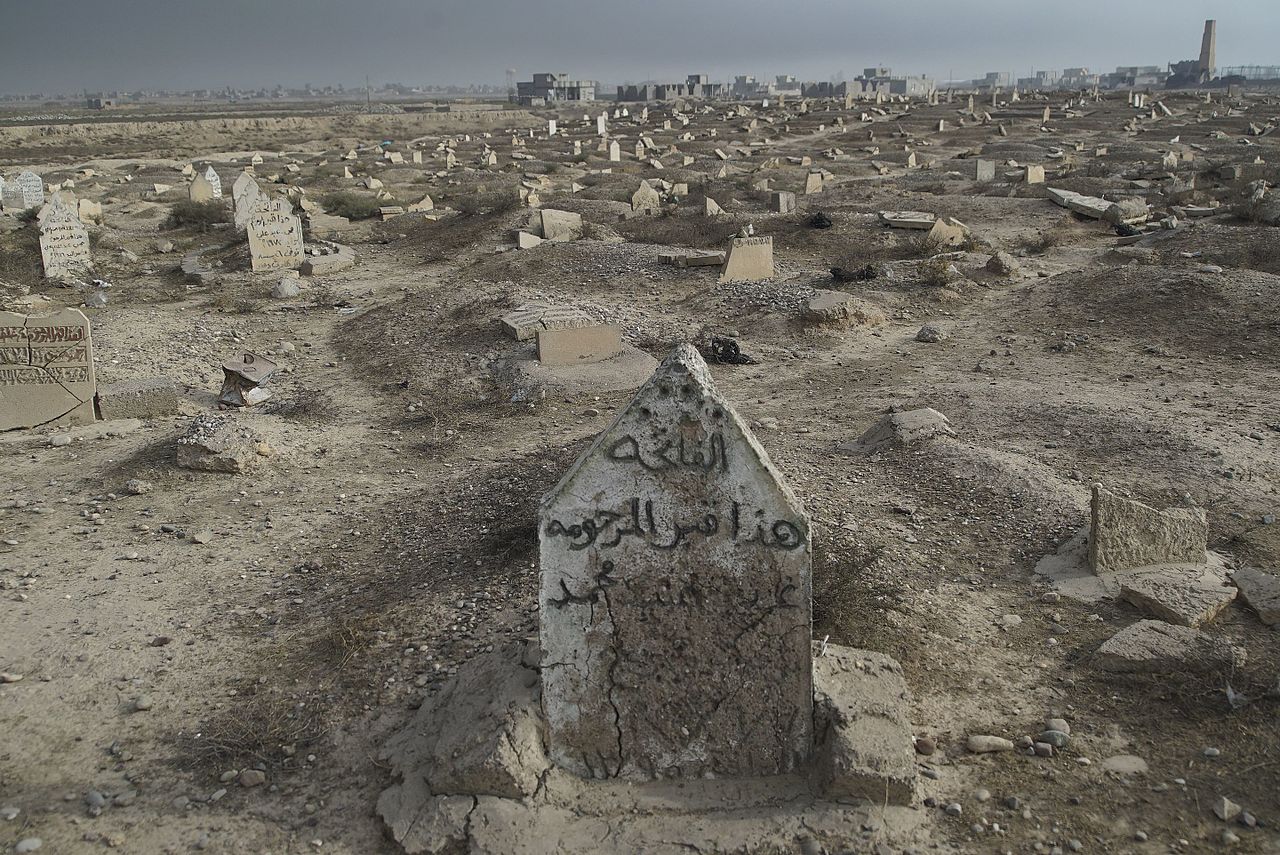
“If these sands could talk – of course they can’t – but if they could…But you know, and I know, that they do speak in their own inimitable way, because if you walk anywhere out into the desert here, not far at all, maybe 50 meters, and you bend over and shove your hand down into the sand and pull up a handful, you will likely find yourself holding pieces of human bone. Those pieces of bone are the remains of our beloved ancestors who either perished from starvation, severe dehydration or were brutalized and killed out here solely because they were Armenian.
“But this is neither the time nor the place to focus on the sorrow of the horrors they faced, for we shall do that later today in a special commemoration at our small but beloved church and museum in town nearby; rather, here and now, we are about something else. And that is to rejoice about how a small but vitally significant number of Armenians survived the genocide, resumed life as difficult as it was, had children and their children had children, generation after generation, and together they rebuilt our community. And they not only survived, but thrived. That was and is a miracle that God almighty bestowed upon us, the Armenian people. And that we must never forget.
Those who survived out here did so, it is worth recalling, through their own grit and good luck, and with the vital and heroic assistance of those Bedouin who offered a helping hand, risking their own precious lives in the process, not to mention the remarkable efforts of the International Red Cross and other key organizations and individuals.
“And though they, the initial remnant, struggled mightily over the years, some much more than others, they ultimately rebuilt their lives and that of our people as a community. And they not only survived, but thrived. That was and that is a miracle that God almighty bestowed upon us, the Armenian people. And that we must never forget.
“While that initial remnant, which was forced to start from scratch since everything had been stolen from them or destroyed, began, as it were, all over again,
the second and third generations continued, through their dedication, hard work and grit, remarkable tenacity and resilience, individually and together, to assist in reviving the Armenians as a people, a community, and a nationality.
“And that is why we are here this morning along the glistening Euphrates. It is to celebrate the rebirth of our people, the continuance of our people, the progress of our people, and the strength of our people, generation after generation, through the birth of new babies/children, Armenian babies and children.
“Here, on the Euphrates, two babies of two pairs of wonderful and young parents are going to be baptized with water from the Euphrates and holy water. The use of the water of the Euphrates, of course, is highly symbolic. Significantly, in our use of the water of the Euphrates as baptismal water we are celebrating the ongoing rebirth of our people, the Armenian people, here in this place, where the intention of the officials of the Ottoman Empire and their minions was to extirpate Armenians from the face of the Earth.”
The Catholicos bent down, dipped a metal pitcher into the Euphrates, filled it, and then stood back up as he handed the pitcher to one of the archbishops. Then he turned toward the first set of parents, gently received the infant in his arms, dipped his fingers into the water, and as he said a prayer, he carefully and slowly sprinkled water onto the crown of the child’s head three times. As the baby girl let out a loud cry, her parents beamed. Then the Catholicos said a final prayer:
“Pounig, the servant of God, coming from the state of catechumen to baptism, is now baptized in the name of the Father and of the Son and of the Holy Spirit. Redeemed by the blood of Christ from servitude to sin, she receives adoption as a child of the heavenly Father, to be a joint heir with Christ and the temple of the Holy Spirit.”
Those gathered along the river’s edge softly but jubilantly clapped as the Catholicos passed the baptized infant back to her parents and then repeated the process with the other infant, a baby, Zorair.
Many of the spectators along the lakeshore wept openly. Perhaps some were weeping while thinking of their grandparents or great grandparents and/or other relatives who had lost their lives during the genocide. Others may have been crying as they thought about the loss of hundreds of thousands of their fellow Armenians due to the harshness and brutality they faced during the genocide. Or, perhaps, some were crying happy tears, as they witnessed the baptisms of the babies and how their births represented the rebirth of the Armenian people.
Dickran continued walking until dusk. When he finally stopped, he swung around in a circle to get a sense as to how far he had walked. As he completed his 360-degree rotation, he was pleased when all he could see in every direction was the sand of the desert. There was no sign of the road from which he had begun his trek or the buildings running along each side of it. Neither could he hear the sound of automobile and truck engines or horns.
Figuring he was out far enough that few, if anyone, would bother him or the edifice that he was about to erect, he, weirdly, thought, “It’s like being out in the middle of the ocean and being unable to see the shore in either direction.”
Slowly, he unpacked his gear, spread it out on a tarp, set up his two-man tent, scrounged around for nearby twigs and branches that were on the ground, started a fire, cooked and ate a small meal of beans and Khobez[v]5, crawled into his tent, hunkered down in his sleeping bag, and immediately fell asleep.
The next morning, as the sun rose over the desert and after a breakfast of cereal with powdered milk mixed with water, Dickran had lugged out with him, he walked out into the desert about a quarter of a mile, and began digging a hole. After about a half hour of digging, to the point where the pile of sand he had just created was about two feet high, he plopped down next to it with a screen box in hand and began sifting through the sand, picking out the chunks of bone as he came across them. Walking about 30 meters further out into the desert, he dumped the bones he had come across., and then went back to digging. This he did day-after-day until his provisions began to run low.
With the exception of returning to town for supplies, the schedule he set for himself the first day of work was the one he adhered to each and every day thereafter: he worked from sunrise to sunset, with only occasional short breaks. As the pile of sand Dickran dug from the hole increasingly grew in size, so did the pile of bones he was in search of.
For six months he toiled alone slowly recreating a rough facsimile of the Armenian Genocide Martyrs’ Memorial Church. The work was grueling under the hot sun. Just as taxing was the constant threat from the fighter jets flying overhead, the occasional missile fired out into the desert, and the army trucks and tanks filing by far out in the desert. Every time he heard a jet and/or vehicles in the vicinity, he quickly jumped into the hole, scrambled to a corner of the hole, hunched down, buried his head in his lap and covered his head and neck with his arms.
As soon as the hole was about four feet deep, Dickran reinforced each side of the hole by placing plywood against each wall and pounding stakes in the bottom of the hole, angling them towards the top, middle and bottom sections of each wall of plywood. He was counting on the effort to prevent the sandy walls from collapsing and suffocating him as he dug deeper and deeper.
Within two months, Dickran had dug a hole fifteen meters in diameter and five meters deep. As he dug, he assiduously created a “safe slope ten meters across at the top.
Next, he fashioned a tall ladder from tree branches he had scrounged, lashing them together so that he could enter and exit the hole each day. Upon filling a large bucket, he climbed out of the hole, grabbed the rope he had anchored up top, which was tied to the bucket handle, and slowly pulled the bucket up and out of the hole, and then emptied its contents a little ways out in the desert. As he repeatedly went through such motions all day long, day after day for months, he became weary of the sameness and backbreaking nature of the work, but at the same time he saw that his vision was, little by little, beginning to take on a concrete shape.
Upon the completion of the hole, he flattened the bottom of the hole so that it was as level as possible. Next, he carved a gigantic circle at the bottom of the hole. Then he carved the outer edges of the circle into another circle in which he was going to place the bones of the dead. At all points around the outer circle it was two feet wide. Next, he spent several weeks spreading out the huge pile of bones he had collected into four enormous piles: large, medium, small and tiny shards.
Upon separating the bones, he placed the largest bones in the bucket, and made his way down the ladder to the bottom of the hole. There, he gently set the bones down inside the circle he had crafted, situating them just so. He did this three more times before the largest bones had all been transferred to the bottom of the hole. Over the course of the afternoon, he repeated the process with the medium-sized and smallest bones. The next morning he carried the shards down into the hole.
Once Dickran had completed the most precious part of the memorial — the glass covered ring of bones — he erected a series of walls radiating out from the center. On each wall he planned to hang photographs, posters, facsimiles of Ottoman Turk promulgations against the Armenians, clothing, newspaper articles, and excerpts from first-person accounts from the period of the genocide.
Dickran wasn’t sure where or how he would obtain the artifacts for the exhibit, but for now his main concern was to complete the construction of the entire edifice. Then and only then would he deal with the artifacts. “The marrow of the story is there, and that’s the key!”
Towards the end of the six months, there were days when Dickran was so lonely, so tired, and so weak that that each step he took felt as if he were trudging through sludge, but he kept at it. As time went on and he became increasingly exhausted and weary, so much so he quit hiding in the hole when fighter jets flew overhead and sometimes even when various actors were engaged in firefights in the far distance. Dickran’s overwhelming exhaustion depleted his sense of preservation of self. All he cared about was completing his work so that he could leave Syria once and for all. As the war continued unabated and he gave his all to the project, he came to hate his birthplace, Syria, with all his heart.
He had had plenty of time to mull over life in Syria under the Assads, first the murderous Ḥāfiẓ al-Assad[vi]6 and then his son, the mass murderer, Bashar Hafez al–Assad. “Murderous bastards who created cults of personality around themselves,” Dickran mused about the fact that Hafez al-Assad essentially forced the Syrian people to refer to him as “The Eternal Leader,” and Syrian officials to call him al-Muqaddas (the sanctified one). “Sanctified one, my ass. And now his bastard of a son, Bashar al-Assad believes he merits the title. What donkey shit!”
IV
Prior to his completion of the basement’s walls, the ground fighting in the region between had intensified and the sound of war went on day and night, with each explosion, sounding outrageously loud and jolting thunder claps, causing Dickran’s body to involuntarily recoil.
No matter how hard he tried not to react, he could not prevent his body from jerking with each explosion. With each jerk of his body, he burst out in fierce epithets.
The greater his frustration became at rushing to complete the job before he was wounded, killed or taken prisoner, the more he found himself screaming, “Yet’e yes karoghanayi dzerrk’s dzerrk’ berel nrants’ vra, yes glukhnery kp’vordzev[vii]7.”
It all came to an end — both Dickran’s efforts and his life — as a result of senseless and vicious cruelty. What he suffered no human being should ever suffer.
His killers played with him the way a feral cat plays with a rat, cornering it, attacking – clawing, scratching, biting, ripping – while flipping it about for its entertainment. When they were tired of playing out their sadistic game, two of the killers, kicked and rolled Dickran’s body over the lip of the hole, sending it tumbling down the deep shaft. It landed hard on the circle of glass holding all of the bones and bone fragments. It bounced slightly in the air once, leaving behind a large reddish smear, before landing half on the glass and half on the floor.
Rumors circulated throughout Deir ez-Zor that Dickran’s killers were not members of ISIS, Al-Qaeda, the Kurdish Syrian Democratic Forces or any of the other splinter groups engaged in the war, but rather Assad’s men. Numerous individuals had seen Assad’s men drive out into the desert, congregate out there, and yell and scream amidst gunshots.
When Dickran’s body was found at the bottom of the deep hole he had dug with his arms and back and heart, there were clear clues that Dickran’s killers were, in fact, not members of ISIS (he had neither been kidnapped nor held for ransom and/or propaganda, and his head had not been chopped off and tossed aside). Instead, Dickran’s face had been beaten beyond recognition into a bloody pulp. His body was covered with gunshot wounds and deep jagged cuts from knives with serrated blades. The latter left Dickran’s skin ripped and torn apart. Cigarette burns covered his stomach and chest. It was obvious that he had suffered an excruciatingly slow and torturous death. Tellingly, it was exactly the kind of death hundreds upon hundreds of civilians had suffered at the hands of Assad’s killers.
[i] Islamic State of Iraq and Syria, a Salafi jihadist militant group whose ultimate goal was to create an Islamic state, or a caliphate, across Iraq, Syria and far beyond. The attack occurred during the Syrian civil war, which began with the Syrian Revolution in March 2011 when Syrian citizens rose up against the vicious Ba’athist regime of Bashar al-Assad.
[ii]2 Bashar al-Assad was a ferocious Syrian dictator who ruled with an iron fist. He was in power from 2000 until his government was overthrown in 2024.
[iii]3 White Helmets: The White Helmets, officially known as Syrian Civil Defence, is a volunteer organization that operated in Turkey and in the then-opposition-controlled parts of Syria before the fall of the Assad regime.
[iv]4 The chief bishop and spiritual leader of Armenia’s national church, the Armenian Apostolic Church, and the worldwide Armenian Diaspora.
[v]5 Khobez: An Arab yeasted flat bread that is soft and thin, and traditionally eaten for breakfast but can be eaten with stews and soups and used to sop up juices, sauces, etc.
[vi]6 Ḥāfiẓ al-Assad: A vicious dictator who ruled Syria for 30 years before dying in June 2000. He was the father of Bashar al-Assad, who followed him as the president/dictator of Syria.
[vii]7 Armenian for: “If I can get my hands on them, I’ll rip their heads off!”