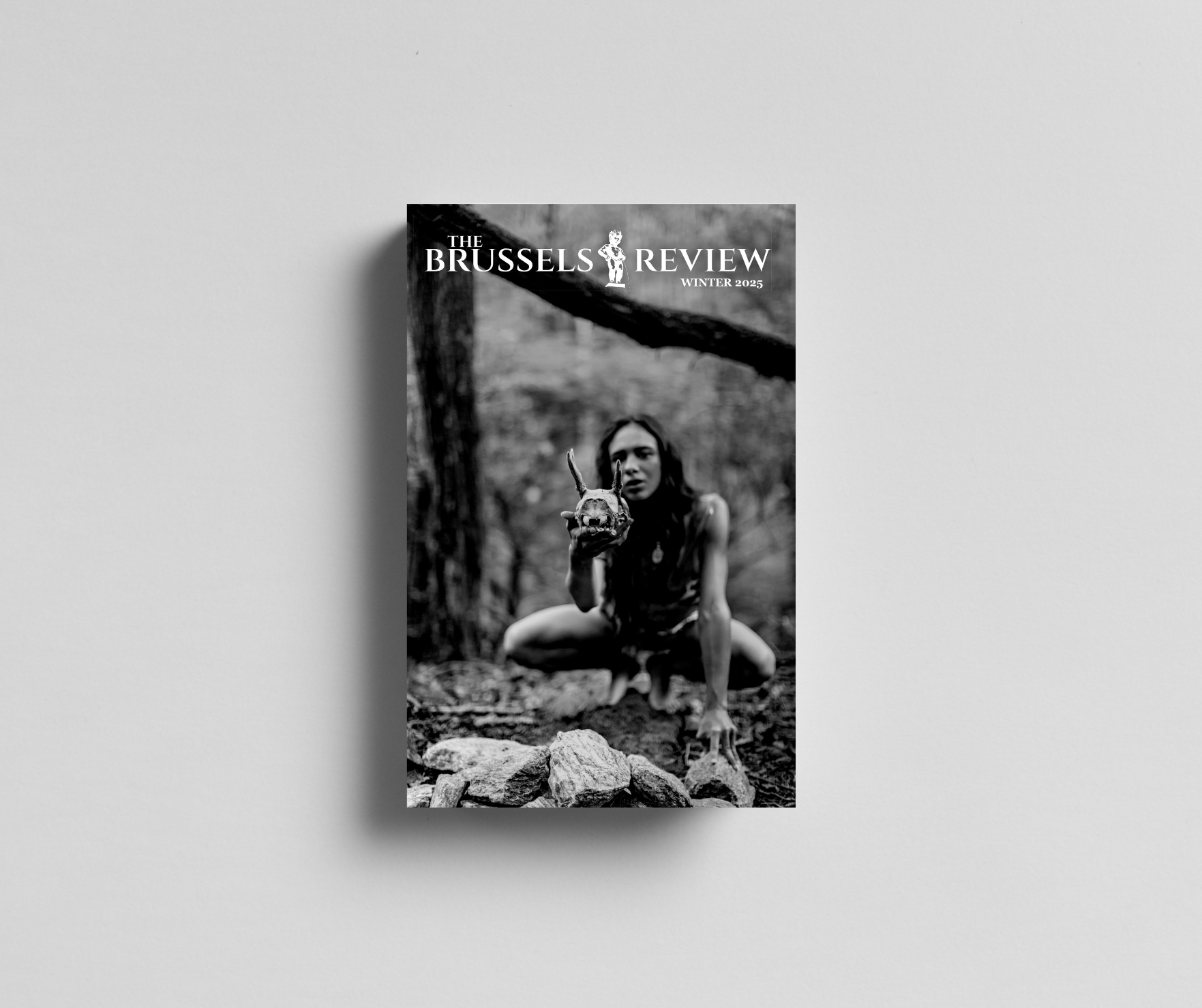
Teresa Krasteva, fiction editor of TBR, talks with Jon Filipek, a Brussels-based writer and lawyer who has lived in Belgium for more than twenty-five years. Alongside a career in regulatory law, he has remained active in fiction and screenwriting and is a long-standing member of the Brussels Writers Workshop. In this episode of Call to the Editor, he discusses Here We Go Again, his flash fiction piece in the Winter 2025 issue of The Brussels Review, reflecting on its origins, the constraints of short form, and the role of repetition, endurance, and perspective in narrative.
Teresa Krasteva: Hello, everybody. My name is Teresa Krasteva. I’m a fiction editor at The Brussels Review, and I’ll be your host for today’s episode of Call to the Editor podcast. This episode is supported by the ACC, the Art and Creativity Consortium. It’s an organization that supports the publication of The Brussels Review and this podcast. If you’re a creator, a writer, a small publisher, a printer, or another organization dedicated to supporting art and literature, please visit ArtCreCon.org to learn more. And for our listeners, we have a surprise: a twenty-five percent offer off your next purchase if you use the code calltotheeditor, valid from now until the end of January. So go ahead and take a look in our shop. Today I’m joined by Jon Filipek, who’s the author of Here We Go Again. It’s a story that’s going to be published in our upcoming Winter issue of The Brussels Review. Hi, Jon, I hope you’re doing well today. Could you introduce yourself briefly; where are you based, and what occupies most of your time these days?
Jon Filipek: Sure. My name is Jon Filipek. I live in Brussels. I was born and raised in the United States, educated there, and have lived in Brussels with my family for upwards of twenty-five years now. I am, by trade, a lawyer and have worked in the legal sphere in various capacities, mostly doing regulatory work here. I would say that sums it up.
Teresa Krasteva: Okay. Well, then I’m interested to know what prompted your journey as a writer. Have you always been a reader or a writer, or did that come later in life, especially being a lawyer?
Jon Filipek: I’ve always been a reader, from the earliest days, and I’ve tried to make time to read fiction in particular. I’ve had aspirations to do some writing, which I’ve found to be challenging given a very busy professional career. I have done so on and off over time since I came to Brussels. I joined a writer’s group, the Brussels Writers Workshop, and have been with them on and off over the years, time permitting.
Teresa Krasteva: Sounds great. What is your writing process like? How do you usually come up with a story?
Jon Filipek: I have a wide variety of interests, I would say, which aren’t necessarily coherent, in various areas. I’ve worked on a script for a feature film, for example, set in revolutionary America. I have started a legal thriller of sorts, which I guess is almost obligatory if you’re a lawyer in the writing sphere, and also some starts on a coming-of-age story. There’s no single coherent theme to my writing. I don’t have a very coherent process either. It’s kind of shifted over time. I used to be very much in the mode of writing late at night, on the weekend, after the family had gone to bed. That was pretty effective, although not necessarily very healthy for the daytime. One of the few lingering positive effects of Covid has been the blossoming of coffee shops all over my neighborhood. There are probably fifteen to twenty within a ten-minute walk of my house. I like going out to coffee shops and writing. It gets me out and about, and I find it pretty inspiring.
Teresa Krasteva: Yeah, yeah, it’s definitely one of those places where you can go either to be social or to get some work done. Somehow it really focuses a person. I like ones that don’t have Wi-Fi, for example.
Jon Filipek: Yes, that’s true.
Teresa Krasteva: I did want to ask you about Here We Go Again. How did that piece come to be? I’ll ask you a few more specific questions in a bit. How did you come up with the idea?
Jon Filipek: Okay. Well, I think it’s fair to say it’s a pretty strange story, and I think the inspiration behind it is even more bizarre. I wanted, first of all, to try my hand at a piece of flash fiction, to tell a story in a thousand words or less and actually finish it. So I guess I would say that’s the predominant motivation. It kind of leverages off a longer piece that I had been writing some years ago and didn’t finish. It’s pretty strange. I have a fascination with these cats that live in the alleys behind my house, that walk the walls and explore the neighborhood. The original story was based on that, about a cat who had nine lives. I lost steam with that story after about four or five lives and set it aside for ten years, then kind of leveraged off that in creating this short story. So the long and short of it is that I wanted to write a piece of flash fiction and use some material I had developed previously.
Teresa Krasteva: It was such an interesting story to read because when I first read it, I could not believe that I was reading the point of view of a dinosaur. I really could not believe you wrote that. Does it happen a lot that you don’t write from the point of view of a person, or is this a strange situation?
Jon Filipek: I’d say it’s a strange situation, yeah. As I said, in the version I was working on earlier, I went through about four or five life cycles before I kind of lost steam. Two of them wind up in the story. I won’t say more than that; I don’t want to spoil it. But two of them wind up in the story, and I thought that made for a good framing with these two life cycles.
Teresa Krasteva: Yeah, exactly. When you mentioned the cats having nine lives, that’s something where you can see how that idea evolved, especially with the flashback scenes we get in the story. I think it made it even more interesting because it’s not just what’s happening right now, but also something from the past coming to light for us as readers. I’m also curious, without spoiling anything, why you ended the piece the way that you did. Was it more of a conscious decision, or more of an emotional one? To me, it was very emotionally effective.
Jon Filipek: This is a story about reincarnation, and it’s not exactly a positive view of reincarnation. Life is hard. It’s a struggle. I thought it worked well to end it the way that I did, suggesting a possible further cycle of life without actually taking the reader there. I think the overall theme is summed up by the title of the piece, Here We Go Again.
Teresa Krasteva: You mentioned earlier that you used to do your best work after the family had gone to bed, and now you prefer coffee shops. Do you listen to music or ambience when you write, or do you need complete silence?
Jon Filipek: I kind of need silence, and I need an avoidance of distraction. I have a lot of distraction in my office, including music in particular and the innumerable traps of the internet. I really haven’t tried writing with music. I assume I would not be very effective writing against the background of music.
Teresa Krasteva: Yeah, even classical music can be distracting.
Jon Filipek: I’ve tried a little jazz, and I find it distracting.
Teresa Krasteva: In terms of structuring your stories, do you get an idea and start writing, or do you outline, even for flash fiction? Or do ideas come suddenly, like in the shower or in bed?
Jon Filipek: I’d say it’s a combination of both approaches. I move forward in a flash of inspiration, but I’m also enough of a planner that I try to think ahead about where the story is going. With the longer piece I had been writing, it was tending toward a form that wasn’t long enough to be a novel, and writing a novel-length treatment wasn’t attractive to me. At the same time, it was really long for a short story. So I decided to truncate it and go with flash fiction, excerpting part of the story. Inspiration doesn’t come automatically. Sometimes it’s hard work, but that’s when things move forward.
Teresa Krasteva: You mentioned that this piece was inspired by cats in your neighborhood. Do other writers, musicians, or artists influence your work?
Jon Filipek: I’m certainly inspired by other writers. I take care to try to avoid imitating styles, but I’m a fan of many authors. George Saunders, for example. Cormac McCarthy is very different. Rachel Kushner is newer on the scene. Just to name a few.
Teresa Krasteva: Does living in Europe influence your writing? Do you think you’d write differently if you were in America?
Jon Filipek: I don’t know. I lived in New York before Brussels, and I could imagine writing a lawyer story set there. I wonder how difficult that will be now that I no longer live there. The story about the cats was inspired directly by what goes on behind my house, with these courtyards and walls. I wouldn’t say that living here has determined the scope of my writing.
Teresa Krasteva: Since you’ve always been a big reader, what advice would you give aspiring writers?
Jon Filipek: The first and most obvious is to sit down and start writing. There are all types of excuses one can come up with, or one can look for a magical formula, but you really just need to sit down and get to it. That’s advice I sometimes find hard to take myself. Also, give yourself some space. It’s not going to magically appear on the page. Some days are more productive than others. Reading is fundamental and can be very inspiring.
Teresa Krasteva: Do you have a sense of the current state of literature? And what is your favorite book of all time?
Jon Filipek: That’s a hard one. I’m afraid I have to cheat. Crime and Punishment. One Hundred Years of Solitude. Blood Meridian. I don’t have a specific genre I admire most. It’s about the quality of the writing. As a recommendation, I often suggest For Whom the Bell Tolls. It’s gripping, with fair prose, moral gravity, and action.
Teresa Krasteva: Lastly, what’s next for you? And where can readers find more of your work?
Jon Filipek: I’m going to try crafting more flash fiction and continue working on longer projects. I have a lawyer story I’d like to work on, possibly excerpting parts as flash fiction. I’ll also continue working on a feature film script I’ve been involved in for the last year or two. In terms of something publishable, probably another piece of flash fiction.
Teresa Krasteva: Thank you, Jon, for a wonderful talk today.
Jon Filipek: Thank you, Teresa. I really enjoyed it.
Teresa Krasteva: Thank you again to the ACC for supporting the podcast and our publication. To our listeners, please follow The Brussels Review on social media at @thebrusselsreview and use the code call to the editor to get twenty-five percent off your next purchase until the end of January. Thank you, and I’ll see you next time.