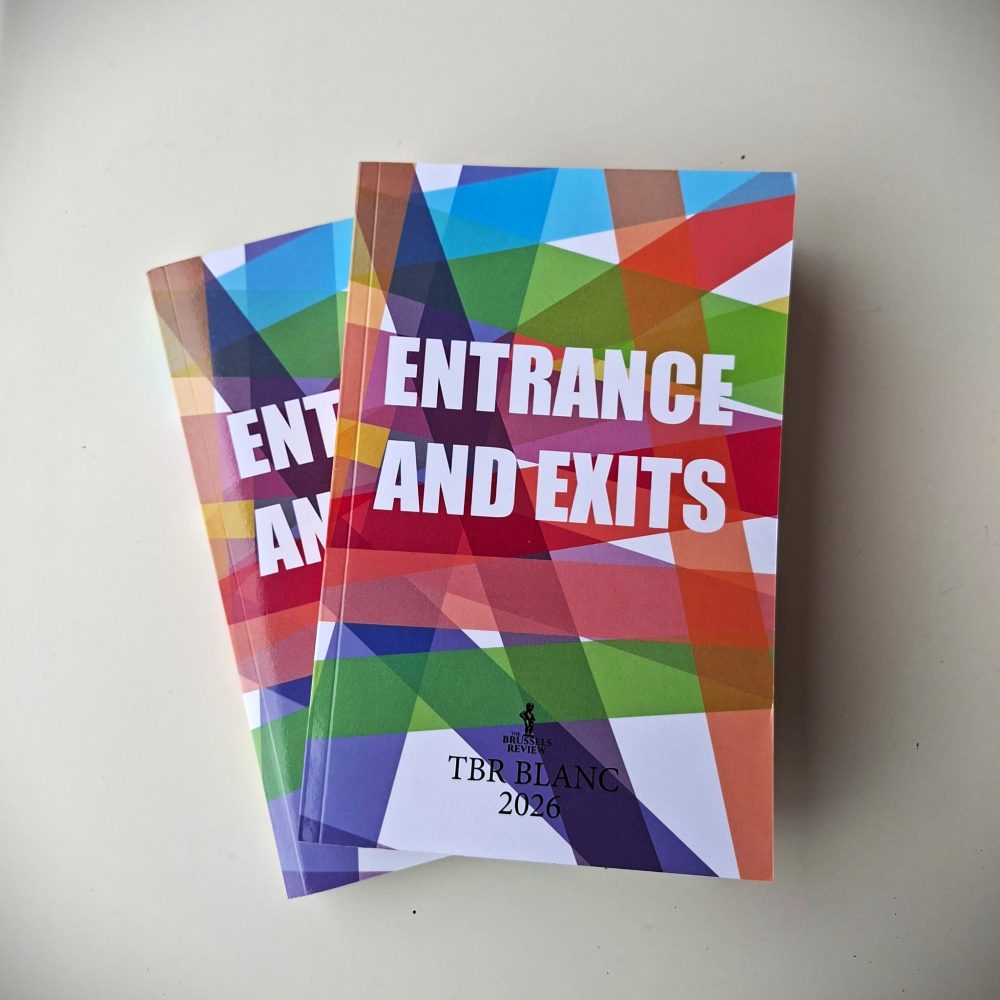
This story was first featured in Winter 2025 issue of TBR.
The reverend didn’t know what to say about suicide, especially when it involved the young. He still thought of Diane as young, even though she’d been in her late forties when she died. He’d known her mother, Ramona, for decades, and Diane was a member of his congregation as a child. Ramona sat in the first pew, hunched forward, face in her palms, as if her head were too heavy. Behind her, the church was full past capacity. Reporters lined the walls on either side of the exit as neatly as a human parapet, their black, cylindrical camera lenses alien and otherworldly. Reverend Thomas questioned his decision to allow them inside.
“Welcome. We are here today to honor Diane’s life.”
The New York Times was there, one of the last national newspapers still around that he remembered from his childhood. His parents were the only people on his suburban Cleveland block in the early 2000s who subscribed to the Times, and when he was a teenager some of his friends made fun of him for it. The Times had sent a single reporter. He knew who was attending because the church had implemented a reservation system due to demand.
This wasn’t the first suicide he’d addressed from the pulpit in his three decades preaching, though there were fewer in his early years. He was young then, too, only twenty-five when he first became a reverend. Now, just past seventy, it seemed to him that they’d become more common. He studied the national suicide rates, but reliable statistics were hard to find. The Free Speech Press, which played a powerful role in determining what research was publicized, claimed that suicides were less common than when he was a boy. An uptick in suicides among the young was counter to their narrative, which was that the world was entering a new state of knowledge and, with it, a new state of human satisfaction.
Their contingent, the FSP’s, was the largest, of course – they had purchased Fox News, NBC, and CNN in the 2040s. Two of their most popular newscasters were there – a man and a woman – both trying to look somber despite their white teeth and swooping hair. The two newscasters were flanked by a team of videographers, half of whom were feeding livestreams that connected to FSP’s army of hundreds of human influencers and thousands of bot influencers. One of FSP’s most popular human influencers was there in person, dressed in bright chartreuse, her trademark. She went by Salandra, and her platform had purchased the Grande Chartreuse monastery near Grenoble; she’d almost single-handedly turned Green Chartreuse into the world’s most popular spirit. Salandra was married to Koby Altman III, whom Reverend Thomas did not see in attendance. There were rumors that he might show up, but Ramona had told the press that she’d rip his throat out if he did. Reverend Thomas told her that might only encourage him.
Koby’s speech to the Pulitzer Committee earlier that year was the first time a Pulitzer Prize acceptance attracted a hundred million viewers. Salandra, who’d been hyping it in advance, told her followers that it surpassed that year’s Super Bowl, which was the only television event that still attracted viewership in the nine figures. Reverend Thomas had hosted a Super Bowl party for the youth group in the church basement. When he was a young minister, his mentor counseled him that events like those were critical for community building. During the game, however, the youth were mostly on their phones, and he didn’t get the sense that the event fostered fellowship. While they swept up chip crumbs off the linoleum and threw away empty soda cans, Ramona told him that turning the church basement into a non-alcoholic sports bar didn’t help anyone. He ignored the comment; he knew she was still grieving, as it had only been two weeks since Diane killed herself.
Diane’s suicide came less than a month after Koby’s Pulitzer acceptance speech, which Salandra had livestreamed from Columbia’s Low Memorial Library to her five hundred million followers. Oh. My. God. She said, before the luncheon began, panning her camera around the room. This building, would everyone just look at this? Who doesn’t love architecture? The stone is so majestic. I’m going to tear up before it even starts. I’m just so proud of Koby. We all should be. At the podium, Koby smiled down at the twenty-member committee who had given him the award. They sat at two round tables to the left of the stage. They looked uncomfortable.
“Hello, hello, hello. I am so psyched to win this award. I know no one expected this – I didn’t either, seriously. I’m just overwhelmed, you know, and I’ll keep my comments short, though I see that everyone has heirloom tomatoes on their plates to throw at me if this goes south.”
The Committee members didn’t laugh, but the Koby and Salandra fans in the standing room section did. Koby had lobbied for them to get seats and to be included in the luncheon, but the Committee told him the seats were limited and catering could handle only a certain number of meals; the Committee viewed holding firm regarding who was served lunch to be a small victory, and they touted it to their more traditionally minded donors.
Someone from the standing room section shouted that they loved Koby and someone else shouted that they wanted Salandra.
“I know, I know. You all wish it were Salandra up on the mic.” He waved to her in the crowd, and she blew an exaggerated kiss. Salandra was seated at a press table and was picking at her special vegan lunch. “She’s busy, though. She has to focus on her livestream – too many people who couldn’t be here today want to see this. This is a triumph for all of us.” Koby brushed his chest as if he had lint on his jacket, looking down at the floor, trying for gravitas. “It may be hard to see, but this is a triumph for humanity, for equity and fairness, for collective achievement. I want to thank my coding team, my parents, and my former Stanford classmates. I learned so much during my year there. And now, to get this award less than five years after dropping out. It’s a dream, really, just a dream. My investors, too – you believed in me and my team, just a bunch of ragtag coders. And my grandpa, who everyone knew as just a basketball guy … He died my freshman year but gave me seed funding – grandpops, I love you, never could have done this without you. And you know we’re going to do so much with this award, this is just the beginning. A shoutout, too, to our readers that made this book a bestseller – we’re so proud to breathe new life into the poetry world, that we were able to connect with all of you, and that’s what’s important here, the feeling that Angel was able to strike in our readers.” The pen name that Koby’s team had written under was Angel Tozija, and the book was titled Reports from the Fifth Dimension.
One year earlier, the Pulitzer Committee had changed to a blind submission process upon pressure from Silicon Valley and Columbia’s largest donor, James Ackman. Ackman’s VC fund backed dozens of AI start-ups, including Koby’s, and he told Columbia’s president that if they wanted the million bitcoins he’d promised for a new lab campus, they’d change. He said it was unfair and made no sense that submissions created by AI were excluded. In an interview, Ackman celebrated the move. “It’s been almost 150 years since the first Pulitzers were awarded in 1917, and for the first time, the Committee won’t be discriminating based on who did the work. If AI cures cancer, are we going to reject the cure? If AI tells the best story, why wouldn’t we read it?” Wall Street traders had speculated that the first large language model AI to win a Pulitzer would see their company valuation grow immediately by a hundredfold.
“And we’ve gotten criticism, so much of it,” Koby continued. “I want to reassure the writers in the room, though. You should feel proud. Our AI, Angel Tozija, she learned from you. All of you. But really, it’s all of us. All humans, I mean. We should feel proud. And hey, Angel still needs editors, she’s not perfect – so, yeah, that’s right, we’re hiring. And you know, to the Committee – I know some of you don’t like me, but I want to credit you for overcoming bias. That’s one of the hardest parts of being human, so hats off to all of you. And to Salandra – baby, we’re gonna celebrate tonight!” Koby lifted his arms toward the library’s domed ceiling, motioning for his supporters to start cheering. They complied, and it was clear he had finished speaking. The Chairman of the Committee, who’d been sitting in an ornate upholstered chair on the stage, rose from his seat and walked toward Koby, holding his certificate and a check for ten bitcoins. Salandra, who got paid a thousand bitcoins per post, turned to her camera and whispered to her followers how generous Koby was, reminding them that the prize money was going to be donated to AI-augmented literacy programs.
Reverend Thomas had been watching with Ramona from her living room, which remained lined by bookshelves mostly filled with worn paperbacks. She had a whole shelf for Diane; her earliest works of poetry from independent presses, later works by major presses, and, finally, her collected anthology, which was published in 2050, five years after her last individual book, ten years after she’d won her Pulitzer, when the New Yorker called her the best American poet since Glück and the most famous since Frost. Beside her poetry were her two books of essays, written in the decades after her anthology, most of which focused on her anti-AI activism. The books of essays had sold well, too, though Diane always complained that it seemed like no one was reading them, that she’d reach more people if she did a two-minute interview with an influencer. As she focused on her essay writing, Diane had also become the face of the anti-AI movement, appearing at political campaigns, on talk shows, and at the few non-FSP owned media outlets.
After Koby finished speaking, Ramona sipped from her wine glass. “I hope Diane isn’t watching this.” Reverend Thomas felt as helpless as he did when members of the congregation asked him for God’s help. He just nodded at her and waited for her to say more. “I remember a conversation I had with Diane around the time her anthology came out. More and more writers were using AI then, defending its use publicly. She told me, ‘Imagine it, Mom. Imagine if I used AI in my work. And let’s say it made the work better. Some people would applaud me for being open-minded, for embracing change, giving rise to a new form of expression, maybe even a higher consciousness. You know what would happen, though, right? The AI would need me less and less, and eventually it wouldn’t need me at all. And maybe what it would produce would be acclaimed, but it would have taken the most precious thing from me. The reason to be alive. And the pit in my stomach that I feel that makes me want to create, that makes me think about what to say … that would be replaced with a deeper pit, a void, and one that I could never fill. That’s why I’ll never use it’.”
Reverend Thomas thought about that moment with Ramona as the funeral proceeded. Diane had asked in her will that no writers, no famous people, get up and give speeches. A few of her old childhood friends spoke about who she was in high school, and then it was time for Reverend Thomas to read Diane’s words. He returned to the lectern, sliding his hands along the decorative velvet as if to smooth it, though it was unwrinkled. He withdrew a paper from the breast pocket of his robe and set it in front of him. He glanced out at the crowd, thinking about how this was the most attention he’d ever gotten, how he could use this moment to spread the word of God. Then he looked at Ramona, who seemed to be reminding him of their history, reminding him that his job was to honor Diane’s wishes.
“I know all of you are here for Diane’s words, not for mine. The words she already spoke and wrote. They touched so many. As has been publicized, Diane did leave a note that she asked to be read at her funeral. I’ll read it now.” He turned his eyes to the page and began reading.
I’m sorry to resort to this. I know that my death will be seen as a statement or possibly even judged as attention seeking. I won’t pretend that that isn’t part of it. It’s about pain, though, as much as it is about attention. Every human who listens to or reads these words knows pain. Even if you wish that you didn’t. Pain is essential to our humanity; this is obvious – we come into the world through pain borne by our mothers. Our species isn’t here without it. We live and love through it and because of it. We try to make sense of it. We create religions.
I used to write poems. They became my religion, I suppose. They didn’t lessen my pain, but they did make me feel just a little less alone. And I know I was fortunate – few poets find their work well known, fewer still make a good living, and even fewer become famous. I didn’t discover anything original through fame. Like many famous artists, I felt uncomfortable and undeserving. So I stopped. Writing poems, that is. Meanwhile, machines were writing more and more poems. And I wondered, is this the world I want, that we want? A world where humans make less art and machines make more? So I tried to write about that.
Before I was born, in the mid-1990s, a chess grandmaster named Garry Kasparov lost a famous match to a computer named Deep Blue. That match was heralded as a landmark moment in the development of AI. Finally, they said, computers are more intelligent than humans – after all, chess is one of our great signifiers of intelligence. That was overblown, of course, and it would take decades for the machines to catch up in other areas. But judges use AI in court cases now, our president was elected by an AI-funded campaign, and our education system is being revamped by so-called AI-augmented learning. Even Kasparov, who was troubled at first when he lost to Deep Blue, eventually came around. He gave interviews later in his life suggesting that we embrace AI, team up with it. He was the chess grandmaster, after all, so maybe he saw an inevitable endgame, saw humanity in an unwinnable position.
I’m not willing to concede, however. My death is not a concession, though I know some of you will see it that way. It’s funny – here, at the end, I find myself back in alignment in at least one way with the church. For those who didn’t see the news, the Catholic Church recently issued a statement saying that AI entities don’t have souls, regardless of what they create in language. I laughed at that when I first read it. Then cried.
And now I am doing something that AI can’t do, that it will never be able to do. I am showing you our capacity for sacrifice. We have long debated what feeling is, what pain is. Among humans, among other animals. And now among machines. But animals can believe in something strongly enough to sacrifice for it. And I, an animal, still believe. And so I end my own life to show you how much I care, how much I feel, and in hopes that this will finally make you hear me. Please do not forget: machines cannot believe in anything, and machines do not feel pain.
Reverend Thomas finished the last line and looked up from the paper. The church was quiet. Even the reporters, who had been murmuring a little, intermittently whispering for their cameras like pre-dawn insects, had fallen silent. Ramona was looking at him with an expression he couldn’t decipher.
“As always, I am thankful to be able to read Diane’s words. There is now just one last piece of the ceremony to be attended to. Diane was cremated, and her ashes are here with us, in this room. The ushers have placed small plastic bags, each containing a sprinkle of her remains, by the door. Diane asked that her friends, family, anyone who attended her funeral, take some away and scatter them somewhere that felt right to them.” Reverend Thomas lifted a small bag and held it up for the crowd to see. “I’ll be following her instructions myself. And before you go, I’d like to share with you my own plans for scattering this bit of Diane.” He held his breath, trying to bring them with him into memory. “I can still see her as a child. Eleven, maybe twelve, she liked to wear red shoes and overalls.” He paused again, letting them be washed down the river. “She spent a lot of time in the church garden back then. For those who haven’t seen it, I encourage you to walk through on your way out. Anyway, the heat never bothered her, the endless hundred-degree days of summer that we have now. Most of the kids wanted to stay inside in July, but she joined me after Sunday school in the garden, and she would prune and weed for hours. The peach trees that you see back there that are now growing so well? Diane helped plant those as a little girl. That is where I will scatter my bag of ashes, so that with time and rain, God willing, they will sink and filter into the soil, be absorbed someday by those tree roots.” He pressed his lips together, looking down and to his left, toward Ramona. “If you find a peach growing there, feel free to take it, and say a thanks to Diane when you do. Please join me in a moment of silent prayer.” Reverend Thomas bowed his head. After thirty seconds passed, he lifted it. “Thank you everyone for coming. Travel safe to your homes.”
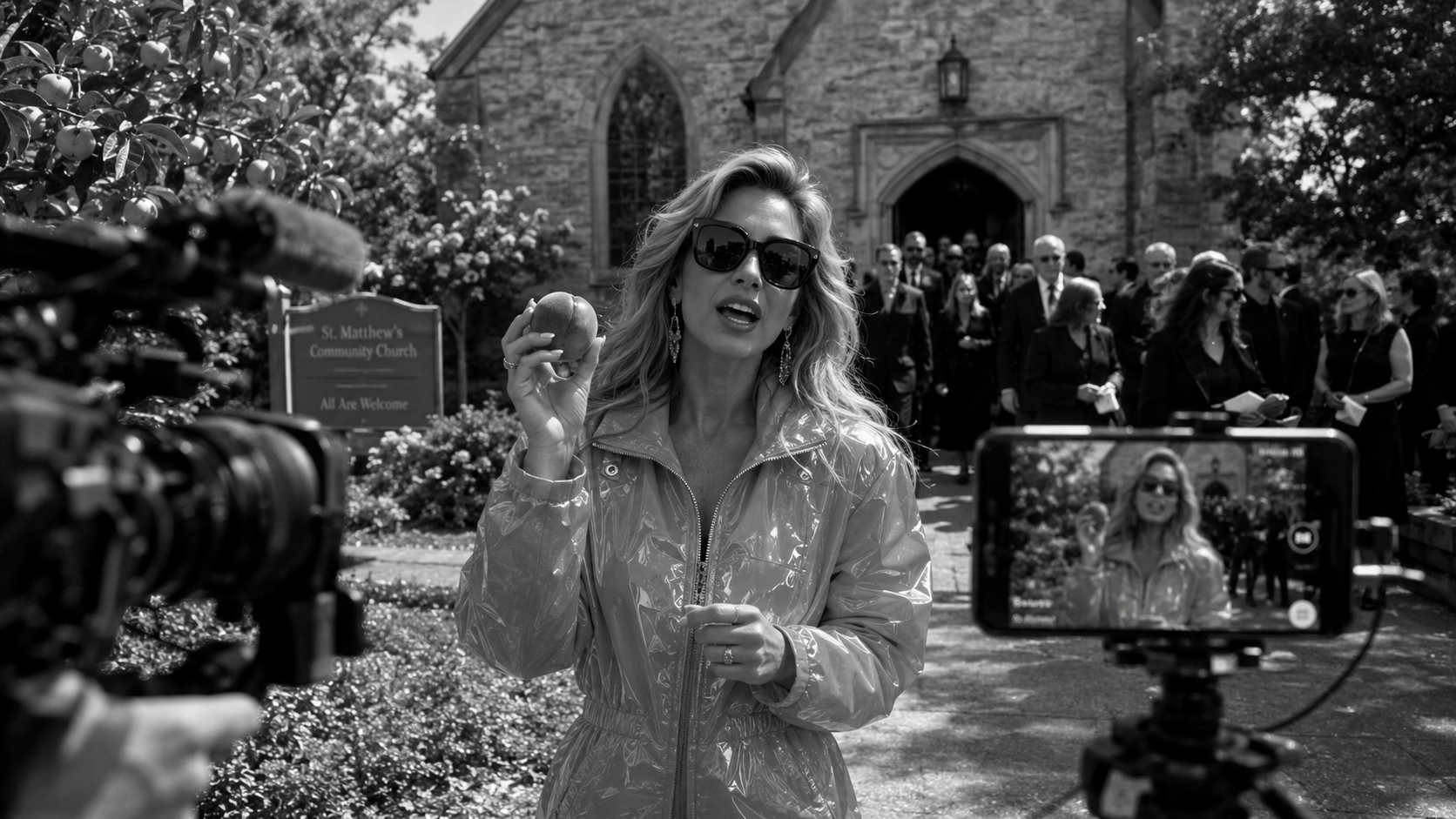
Salandra was one of the first to leave the church; most of the cameras were still inside, trying to get interviews with the reverend, Ramona, or other attendees. Salandra’s content always got the highest engagement when she was the sole speaker, though, and so she had instructed her video team to pan along as she strolled through the garden, pulling a ripe peach down, taking a moment of quiet reflection. Then she returned to the front of the church, positioning herself to have the best vantage point for the cameras to capture her face with the stream of mourners filing out behind her. Her chartreuse jacket glimmered like colored ice in the sunlight. “What a statement, and what a life. It is just so tragic. That was so hard – I know all of you were as touched as I am. And what an amazing gesture for her to share her ashes with all of us. And that reverend? Oh my god everyone, we should livestream all of his services, shouldn’t we?” She held up the peach. “And, y’all, what about the peaches? Can you believe it? I think it is a sign. You know how often I tell you to eat fresh fruit. It’s just so beautiful, and it is such a good reminder for all of us of what’s important. Like Diane, I love trees. They’re so amazing. And peaches, don’t forget, are a superfood.”
She dropped the peach out of the frame, inhaled deeply, and then looked up again into the camera. “Koby and I are going to meditate on this for a day or two. We have to go through the grieving process. I know all of you do, too. In the meantime, I’m going to be launching a poll to see what everyone would like us to do with the ashes, the best way for us to honor this beautiful life.” She wiped at her eyes and swallowed. “And I don’t want to leave without acknowledging something else. I know that this may have been triggering for some; I have some great resources for hotlines and other links that I’ll put in the comments to this post. Thank you so much for tuning in. I can’t wait to talk to you all again tomorrow.”