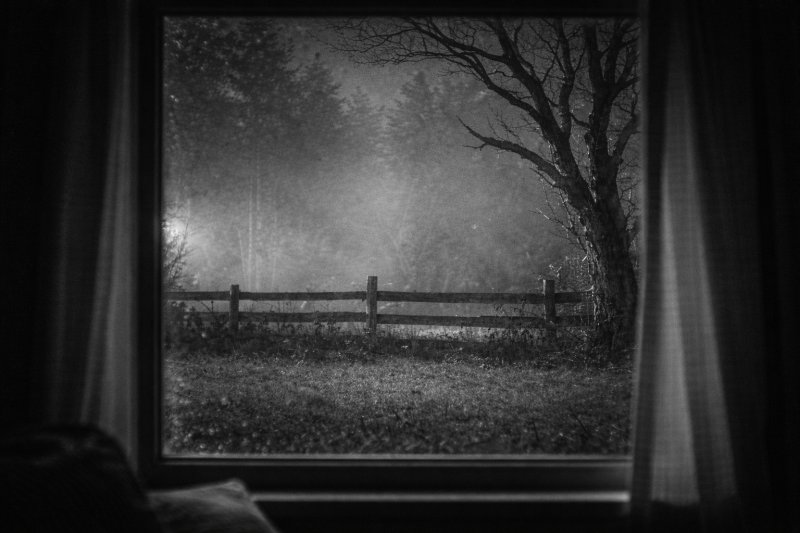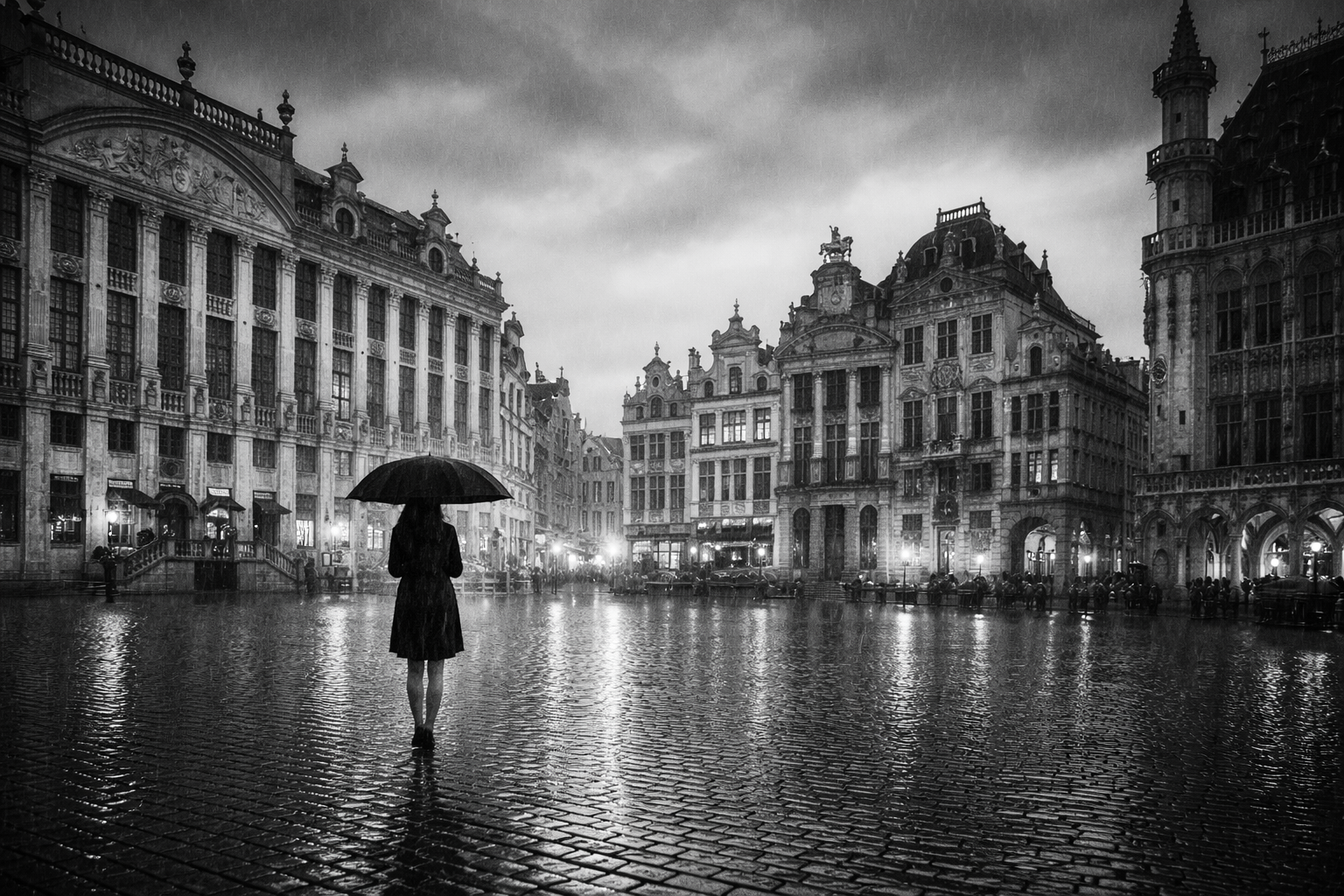
It was three in the afternoon, but it may as well have been nine in the evening. The sun was tucked behind layers of velvet curtain clouds that cast a cool grey haze the shade of the crumbling stone of the old monastery that marked the western edge of the town, forming a boundary between civilisation and the unforgiving mountains. Their peaks of exposed stone reached out from their grass-covered bases and disappeared into the mist. The streets were emptied save for a figure silhouetted by a lamp at the front of the train station. Its fluorescence illuminated a nylon hood, the water off which cast a halo. Moisture gathered and clung to the ends of the hair that framed her face.
Idle chatter drifted from inside the train station, but she could not make out what was being said. She slung a black canvas rucksack over her shoulder and stepped into the shade of the afternoon, and suddenly she was washed over in greyscale. She walked along the town’s main street, arguably its only, the exposed plastic on the worn-down heels of her boots clicking as loud as horseshoes in the stillness. The streets were usually vacant in less-than-ideal weather, but she thought, gratefully, that it was more desolate than usual. She was rarely alone when she ventured through town, and now each step she took seemed to ring in her ears, which she took to counting. Boarded up beauty salons and cobblers lined the road; a solo operating newsagent; one long obsolete pub, its name printed in peeling lettering; two pubs with their doors flung open inward, beckoning; and one dual use pub and undertaker, a relic of the lucrative business of pint pouring and body burying of previous centuries. She didn’t think the undertaking services advertised were much more than a facetious attempt at nostalgia for the townsfolk who still saw the town through rose tinted glasses.
No sooner had she started on the road, she felt, she had walked the length of it, to the town’s only apartment complex: twelve units contained in a dull block with too few windows and painted a despondent shade of pale yellow. The door to her apartment was ornamented with a mat, a relic from the previous tenant, and a pair of work boots crusted with days-old mud. Her keys clanked against the door and the lock rolled with an audible thump as she opened it.
He was not there, not sprawled across the couch, the news not playing to an absent mind. His things were still there as proof of his former presence, a record player, a raincoat, his collection of books dating from his schooldays to a few months ago. A tin of his specific brand of coffee was left out on the counter. His favourite mug, a gift from his niece from a school trip to Paris, left upside down in the dish rack. She pressed the bedroom door ajar, and turned the light on in the bathroom, and, having resolved herself to the silence and the singular toothbrush in the cup on the sink, wandered back out into the kitchen. The rain picked up and rapped aggressively on the slanted overhead windows.
She wondered if she should take the photos from display on the bookshelf. Were they memories seized by some God-force and stamped on paper or leering reminders that everything went wrong? She held the faded Polaroid from a friend’s birthday party that captured her arms around his shoulders and his right arm around her waist as she leaned backwards, laughing at something unremembered, his gaze cast downward in a half smile at the drink he held in his lap. It was tucked into the frame of another photo taken of them at his sister’s wedding in Spain. She remembered the intense, unrelenting heat of the August sun , and his parents taking the photo at their hotel before leaving for the chapel, a rustic, one-room building scarred by the Spanish Civil War. She had taken her sunglasses off for the photo, and in the sixty seconds it took to take it, the sun boiled the wetness in her eyes. Tears beaded at the edges of her squinted eyes, and he said, ‘Jesus, it’s a wedding not a funeral!’ Or something along those lines that faded now, and the squint that was captured emerged from the corners of her mouth pushing the apples of her cheeks into her eyes, and her red eyes were not lashed into permanence. In his face in the photos, she still saw hers, though she had searched his features in recent months and found no traces of herself, nor did the chord of his voice reflect the tune she remembered him speaking in. She left the photos as they were. The jolt that ran through her still left the heat of the Spanish sun on her muscles, warming their stiffness momentarily. She turned away from them.
The quietness that draped over the apartment created a void in the room unlike the silence she came home to when he was still at work. The rain hammered at the window with a particularly insistent intensity. She absently switched on the television. The news anchor stared through her as she delivered the facts of some latest atrocity, but with the woman’s measured cadence filling the room, she felt less alone. Mechanically, she set about putting away the coffee, the mug, emptying her backpack. She was neither performing the actions nor listening to the news but suspended in the abyss in between, where she had to consider neither. The usual modicum of untidiness that followed him had disappeared, even the bin was emptied, and the sink was scrubbed. Was she to change the linens on the bed now? Would sleeping on his scent when he was no longer around be as alien as sleeping in a stranger’s bed, or would she rouse in the night tireless after having found herself alone?
She boiled the kettle, but it was cold before she poured it over a tea bag. The water turned a feeble shade of grey as she watched the bag wheeze its essence into the liquid. From the press, she pulled boxes of cereal and baking supplies. Her arm, swallowed by the cabinet, reemerged with half a bottle of red wine crowned with a maroon-stained cork. It was bought the day before she left to stay with her parents, five days earlier. She didn’t normally keep alcohol in the house, but he had gone that night and her nerves were as taut as a bowstring.
She poured a small measure into an oversized wine glass, drank it in one go, then filled it to the nearly invisible 175 millilitre mark. Even with the hum of the news still resonating, the apartment was still hollow, and she felt as though she were in some remote cabin, far removed from even the tiny village. The view of the looming mountainside that snuffed out any of the navy dusk, eclipsing her window in inky black, did not help. The phone rang, reminding her that despite her brooding isolation, she was never fully alone in the 21st century.
‘He’s not here, Catherine,’ she said before the voice on the other end could get a word in.
‘Did he get the car looked at?’
‘I don’t know. He’s not here. He moved out, remember?’
‘I thought you might have spoken to him.’
‘I haven’t.’
‘Don’t you think you ought to?’
‘No.’
The line was silent. Catherine’s first time without an opinion.
‘Is there anything I can help you with, Catherine?’ She rubbed the tiredness from her eyes and dropped onto the couch sideways, pooling onto the cushions with her legs over its arm.
The old woman sighed audibly, blowing static through the microphone.
‘Aren’t you worried about him?’
‘I am always worried. That’s why I can’t have him here anymore.’
‘If you talk to him, tell him to ring me.’
‘If he’s not answering, try the pub.’
She hung up before she would have to face another intrusive question. She contemplated blocking the number but decided it to be too cruel. Catherine meant well, despite having trouble with boundaries. It was her generation, her rural upbringing, her lack of experience outside the village where everyone knew each other’s business.
She watched the news ticker roll across the screen without reading its words. She switched off the television, the red strip still lingering in her vision against the black backdrop. There was a purple stain in her glass where the bowl met the stem and she swirled the parched drop around, twirling the stem in between her fingers. She didn’t know if she would move or if she would get used to claiming their shared apartment as her own. Catherine’s words, aren’t you worried, dug a hollow in her chest and planted themselves there. She was more worried than ever, with him gone where she couldn’t keep her eye on him and where the future was uncertain. Her death grip on authority dug its nails into the edges of the cavity Catherine’s words created.
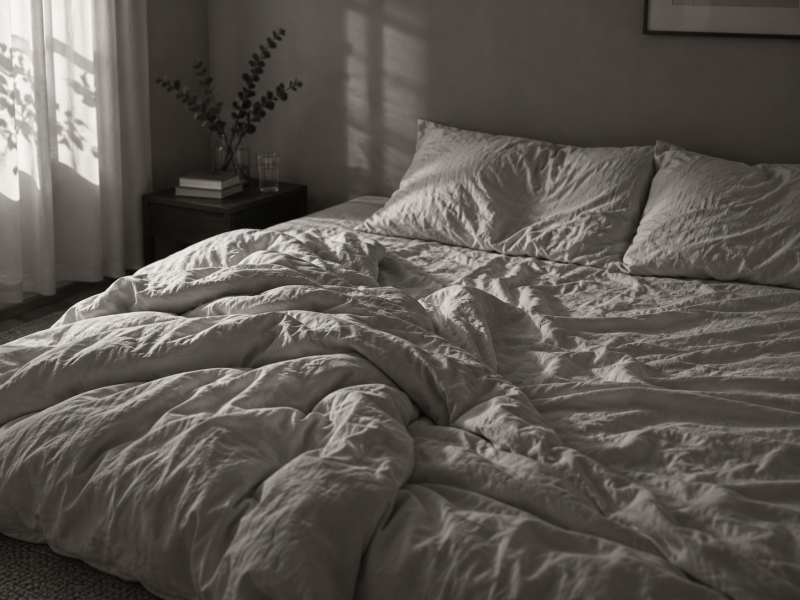
Aren’t you worried, she asked herself. No, she responded. It was hard to pretend in such an obvious lie. Where was he now? He was not hidden in the darkness out the window, even though she didn’t expect to find him there. He was staying with a friend just on the outskirts of town until he had a more permanent plan, but without being there, she may as well have been in another universe, another timeline. He was gone, but traces of him were embedded in every corner of the apartment. His curly hairs were stuck to her sweater, tangling with wool and her own long ones. The last record he listened to was still on the platter of the record player. She didn’t look to see what it was. The table had a burn mark at the centre where he once left a candle burning until it extinguished itself, and, defiant to its mortality, or in spite of it, it scorched the finish. He was everywhere, even where he wasn’t. He wasn’t there, but she saw him as he busied himself in the corner, at the table, with books. She decided she needed to change the bedsheets.